


Your online reputation is the first sales conversation you never get to attend. Before a homeowner calls an HVAC company, a plumber, or a pest-control tech, they open Google, skim a few reviews, glance at the star rating, and decide who to trust — usually before they ever pick up the phone. Online reputation management is how you win that conversation on purpose instead of leaving it to chance.
For a home-service business, it comes down to a handful of concrete things: how many recent Google reviews you have, what your rating is, how fast you reply, and whether your business details are correct everywhere a customer looks. Get those right and you rank higher in local search, earn more calls, and close more of them. Get them wrong and the job goes to the company one spot above you.
This is the working playbook: what reputation management actually is, why it moves revenue, the system that runs it, and how to handle the bad review that will eventually land.
What online reputation management actually is
Online reputation management — ORM, in plain terms — is the practice of shaping what a potential customer finds when they look you up — your reviews, your star rating, your business listings, and your search results. It is broader than review management, which is one piece of it. Review management covers generating, monitoring, and responding to reviews. Reputation management wraps around that and adds everything else a buyer checks before deciding: your Google Business Profile, your listings across directories, and the overall impression a first-time customer forms in the thirty seconds they spend choosing — see what a stranger notices about yours, free.
For a local service business, that impression is built almost entirely from Google. A strong, recent set of reviews does two jobs at once: it convinces the person reading them, and it signals to Google that you are an active, trusted business worth ranking. That is why reputation and local SEO are really the same project.
Why it moves revenue, not just feelings
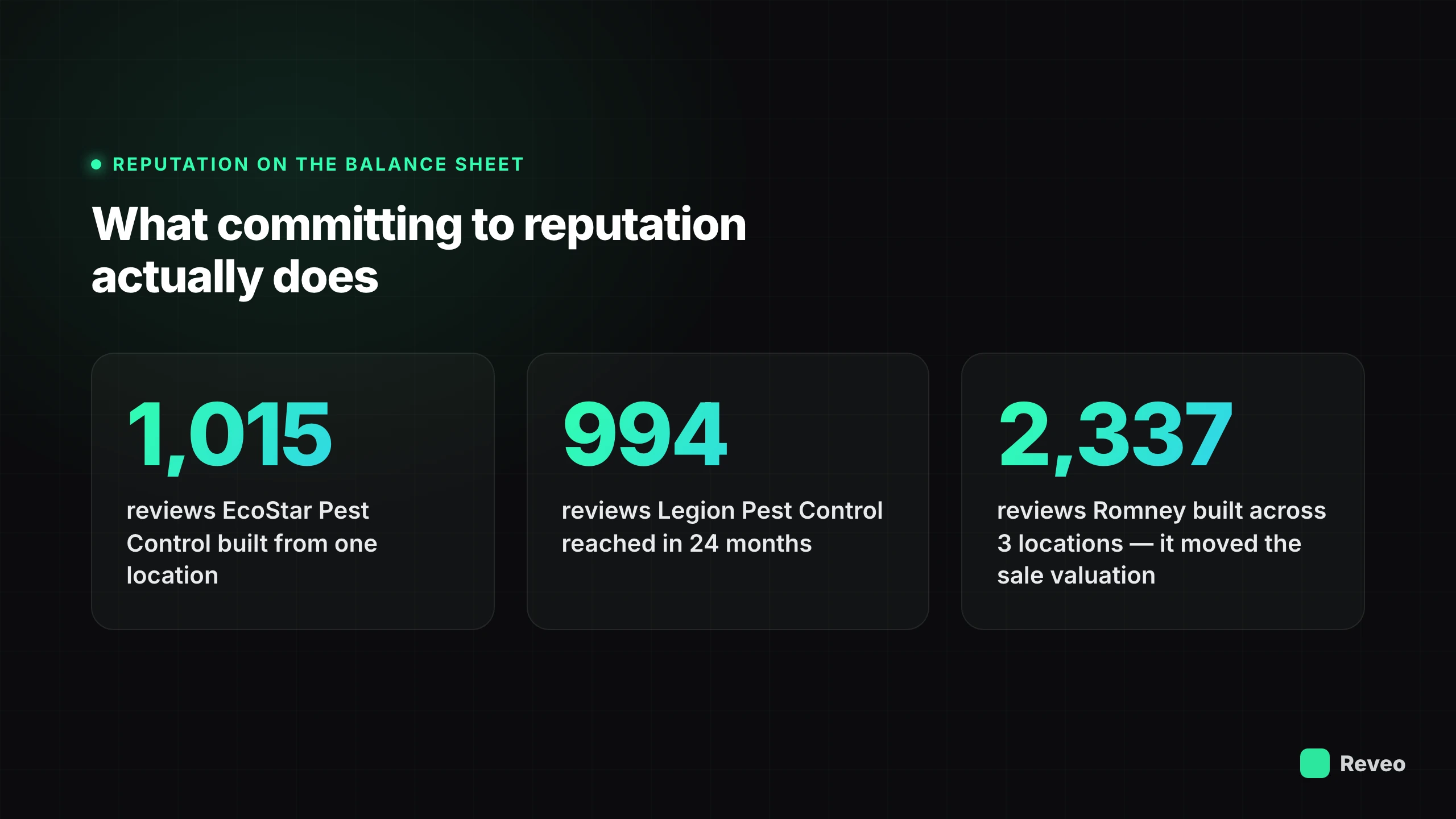
Reputation is easy to file under “nice to have.” It isn’t. It is one of the few levers that changes how many calls you get and how many of those calls close. The proof is in what happens when a home-service company actually commits to it:
- EcoStar Pest Control built 1,015 Google reviews from a single location — the kind of density you normally only see from a regional chain. As owner Pete Updike puts it, most pest companies in his area have 50 to 200 reviews, so customers click EcoStar first.
- Legion Pest Control reached 994 reviews in 24 months and stopped worrying about it: “I look at the dashboard once a week. The system runs itself.”
- Romney Pest Control built 2,337 reviews across three locations — and when the owner sold the company, that review density directly influenced the valuation. Reputation showed up on the balance sheet.
BrightLocal’s annual local-consumer survey has found for years that the large majority of people read reviews before choosing a local business — and there’s more reputation data worth trusting if you want the full picture. None of the results above came from an ad budget. They came from asking every customer, every job, without fail — which is a system, not a campaign.
The system: four parts that feed each other
A reputation that grows on its own has four moving parts. Skip one and the whole thing turns manual.
1. Review generation. The engine. You have to ask every customer, right after the job, in the channel they actually answer — which for home services is a text, not an email. The companies above didn’t get more reviews by asking better; they got more by asking every time, automatically, the moment a job closed. The review link you send matters too — make it one tap to a five-star rating.
2. Review management. Reply to everything, good and bad. A reply to a five-star review costs thirty seconds and tells the next reader you are paying attention. A reply to a one-star review matters even more, because future customers judge how you handled it, not just what happened. Here is the playbook for responding to negative reviews.
3. Listings accuracy. Your name, address, and phone number have to match everywhere — Google, Facebook, Yelp, Apple, and the industry directories. Inconsistent listings confuse Google and quietly cost you local ranking. Fix your Google Business Profile first; it is the one customers actually see, and a reputation platform that also manages listings keeps the rest from drifting.
4. Social proof. Your reviews are your best marketing, and most businesses let them sit on Google doing a single job. Put your strongest ones on your website, in your ads, and on social — the trust that wins the click on Google wins it everywhere else. Here’s how to build that asset deliberately, step by step.
Each part feeds the next: more reviews lift your ranking, a higher ranking brings more customers, more customers produce more reviews. Take the manual step out of the middle and the loop runs itself.
Make it automatic, or it won’t happen
The reason most home-service businesses have 40 reviews instead of 400 is not effort — it’s memory. Techs finish the job, get in the truck, and the ask never happens. The fix is to take the person out of the loop.
Wire the review request to fire automatically when a job is marked complete in your field software — FieldRoutes, ServiceTitan, Jobber, Housecall Pro — so the text goes out while the customer is still standing in a cool house or a clean kitchen. That timing is most of the battle: a request sent within the hour converts far better than one sent the next day. Add AI-drafted replies so responding to every review takes minutes instead of an afternoon, and alerts so a new negative review reaches you the same day, not the next week.
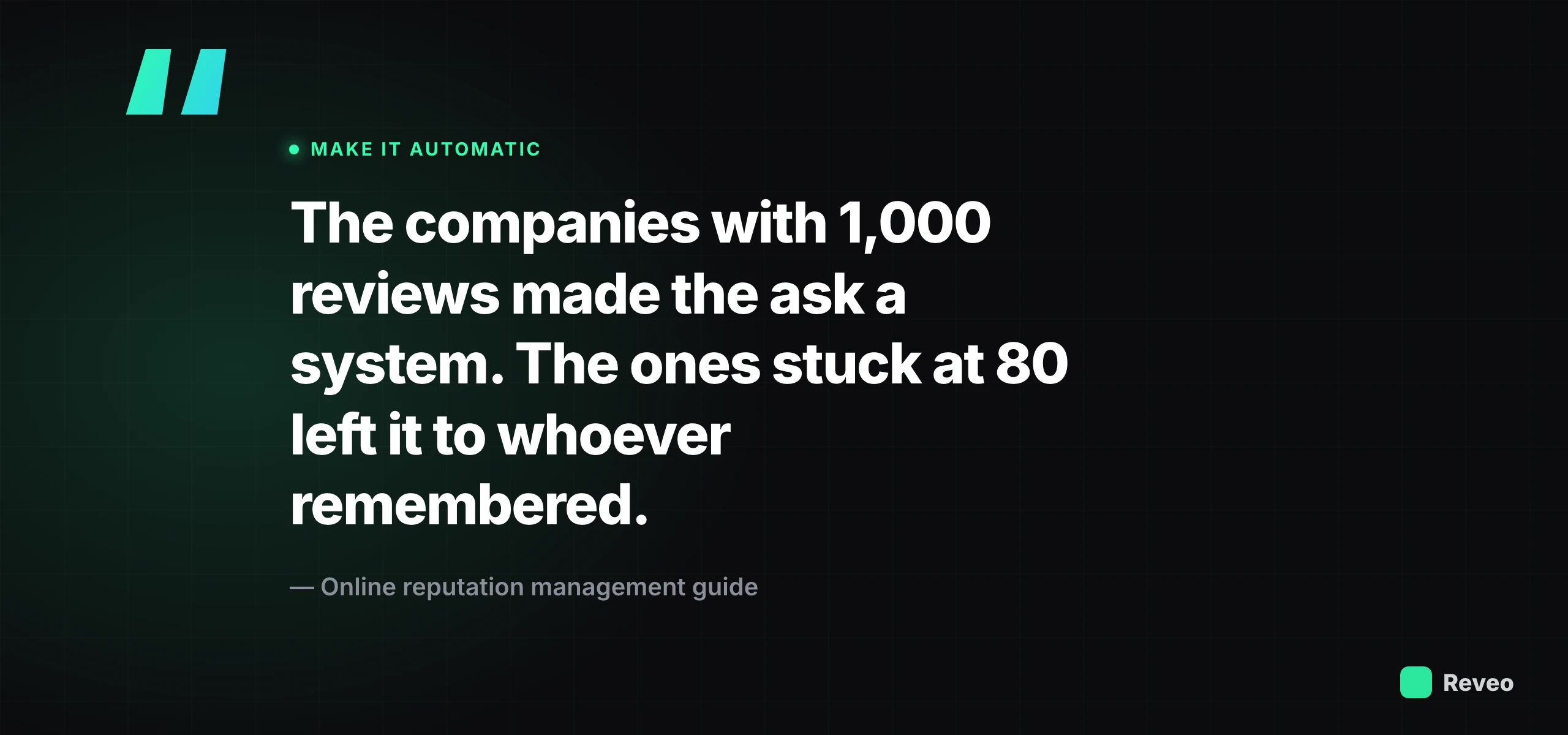
That is the whole difference between the companies with 1,000 reviews and the ones stuck at 80. The first group made the ask a system. The second group left it to whoever remembered.
When the bad review comes — because it will
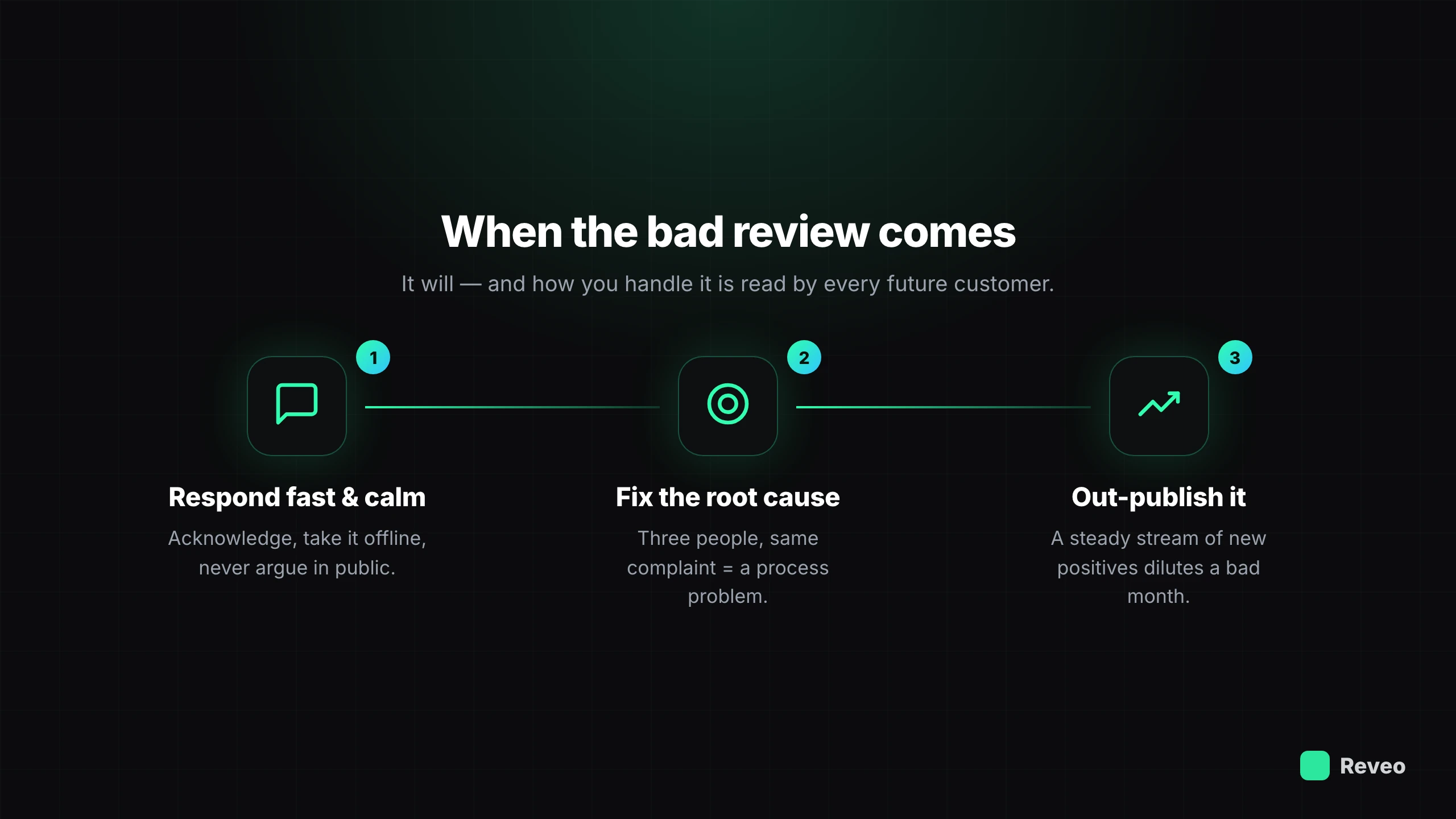
Even great operators get a bad review. Here’s the full response playbook, step by step, when you need more than the summary below. A missed window, an off day, a customer you were never going to please. The damage comes less from the review itself than from how you answer it — and from having enough recent positive reviews that one bad one barely moves your average.
Three things handle it:
- Respond fast and calm. Acknowledge, take it offline, and never argue in public. Future customers are the real audience.
- Fix the root cause. If three people mention the same thing, it’s a process problem, not a review problem.
- Out-publish it. The most reliable way to bury a negative is a steady stream of new positives. Velocity dilutes a bad month.
This is exactly why the generation engine matters. A business collecting reviews every week barely feels a one-star review; a business with 30 reviews total feels every one.
Where to start this week
You don’t need a project. You need three moves:
- Turn on automatic review requests for every completed job, sent by text within the hour.
- Reply to every review you haven’t answered — start with the negative ones.
- Fix your Google Business Profile so your hours, phone, and services are correct.
Do those three consistently and your rating, your review count, and your local ranking all start moving in the same direction — the same compounding that turned EcoStar’s and Romney’s review counts into a real competitive edge.
Want the fill-in-the-blank version to track yourself over time? Download the free reputation health audit worksheet — or run the automated version below and get the same score in two minutes.
Want to see where you stand today? Run a free reputation scan for a snapshot of your reviews, rating, and listings in a couple of minutes.