


Local SEO is how a home-service business shows up in the three-result map pack when someone nearby searches “plumber near me” or “HVAC repair in Phoenix.” Win that spot and you get the call; lose it and the job goes to the company ranked above you, no matter how good your work is. For a plumber, HVAC company, pest-control tech, or roofer, local search is the single biggest source of new customers you don’t already know — and unlike ads, the ranking you build keeps paying after you stop spending.
The mechanics are narrower than most guides make them sound. Google decides your local rank on three things it calls relevance, distance, and prominence — and for a service business, the levers you actually control come down to a complete Google Business Profile, accurate listings everywhere, a website that names your services and cities, and a steady flow of recent reviews. This guide walks each one in the order I’d fix them, with the tradeoffs nobody mentions.
How Google actually ranks local results
Two different result types show up when someone searches for a service near them, and they follow different rules.
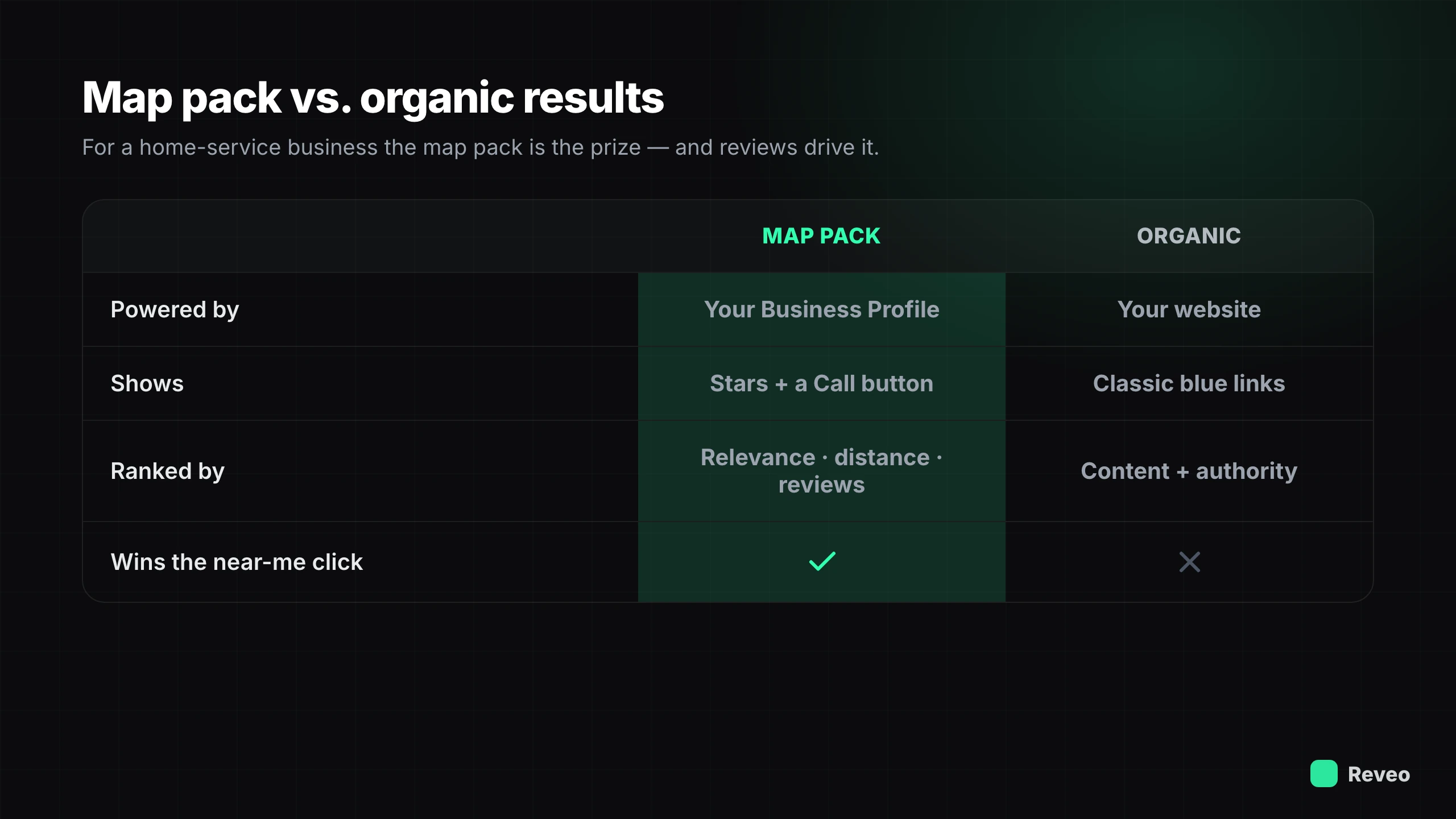
The map pack (also called the local pack or 3-pack) is the block of three businesses with a map, star ratings, and a “Call” button. It’s powered by your Google Business Profile, not your website, and it’s where most of the clicks and calls go on a “near me” search. The organic results below it are the classic blue links, ranked more like normal SEO — your website’s content and authority.
You want both, but for a home-service business the map pack is the prize. It sits above the fold, it’s built for phones, and it hands the customer a phone number before they ever visit a site. Google has been public for years that it ranks the pack on three factors: relevance (does your profile match what they searched), distance (how close you are to the searcher), and prominence (how well-known and trusted you are, which is heavily driven by reviews). You can’t move your trucks closer to every searcher, so the game is winning on relevance and prominence — and that’s most of what follows.
Google Business Profile: the foundation
Your Google Business Profile (GBP) is the most valuable asset you own in local search. It’s the listing that feeds the map pack, and a half-finished one is the most common reason a good company ranks below a worse one. Fill in everything — not the greatest hits, everything:
- Primary and secondary categories. Your primary category (“Pest Control Service,” “HVAC Contractor”) carries real ranking weight, so pick the most specific one that fits, then add secondaries for the other services you offer. This is the field owners most often get wrong.
- Services and service areas. List every service by name and set the actual cities and zip codes you cover. Google uses these to match you to searches you’d otherwise miss.
- Photos, and keep adding them. Real photos of your crew, trucks, and completed jobs — added regularly, not dumped once. A profile that keeps getting fresh images reads as an active business.
- Hours, phone, and booking. Correct hours, a local number, and messaging or booking turned on if you’ll actually answer. Google favors profiles customers can act on.
- Google Posts and Q&A. Post seasonal offers and updates, and answer questions publicly. It’s free real estate most competitors ignore.
One tradeoff worth naming: do not stuff your business name field with keywords (“Phoenix Best Cheap AC Repair LLC”) unless that’s your real registered name. It’s against Google’s guidelines, competitors will report it, and a suspended profile drops you out of local results entirely for days. The reward isn’t worth the risk.
Reviews: the ranking signal you control most directly
Reviews are the part of prominence you can move fastest, and they’re the reason most home-service companies stall in local search. Google weighs your review volume, velocity, recency, and the words customers use — a company earning a few reviews every week outranks one sitting on 40 reviews from two years ago, even if the star ratings match. Recency and pace are signals, not just the total.
This is where the work actually pays off, and I’ve watched it happen:
- EcoStar Pest Control built 1,015 Google reviews from a single location — review density you normally only see from a regional chain. When most competitors in their area sit at 50 to 200 reviews, EcoStar is the obvious first click and the profile Google trusts most.
- Romney Pest Control reached 2,337 reviews, and when the owner sold the company, that review density directly influenced the sale valuation. Local prominence showed up on the balance sheet.
- Scoop Soldiers, a 47-location pet-waste franchise, roughly 10בd its review velocity once it stopped asking manually and let the requests fire automatically after every job.
None of that came from asking better. It came from asking every customer, every job, automatically — the moment the work was done, by text, while the customer was still standing in a cool house or a clean yard. A request sent within the hour converts far better than one sent the next day, because the person who never opens email will tap a text. That timing, run as a system instead of a to-do, is the whole difference between the companies with 1,000 reviews and the ones stuck at 80.
Two things beyond volume: respond to reviews — every one, good and bad, ideally inside a day or two, because Google rewards active profiles and future customers read your reply to the one-star review more closely than the review itself. And note that the keywords customers naturally use (“they fixed our AC fast,” “great termite treatment”) feed the relevance Google matches against. You can’t script those, but a high volume of real reviews produces them for free.
On-page SEO: the website’s job
The map pack runs on your GBP, but your website decides your organic rankings and reinforces the pack. Google reads your site to understand exactly what you do and where, so the pages have to say it plainly.
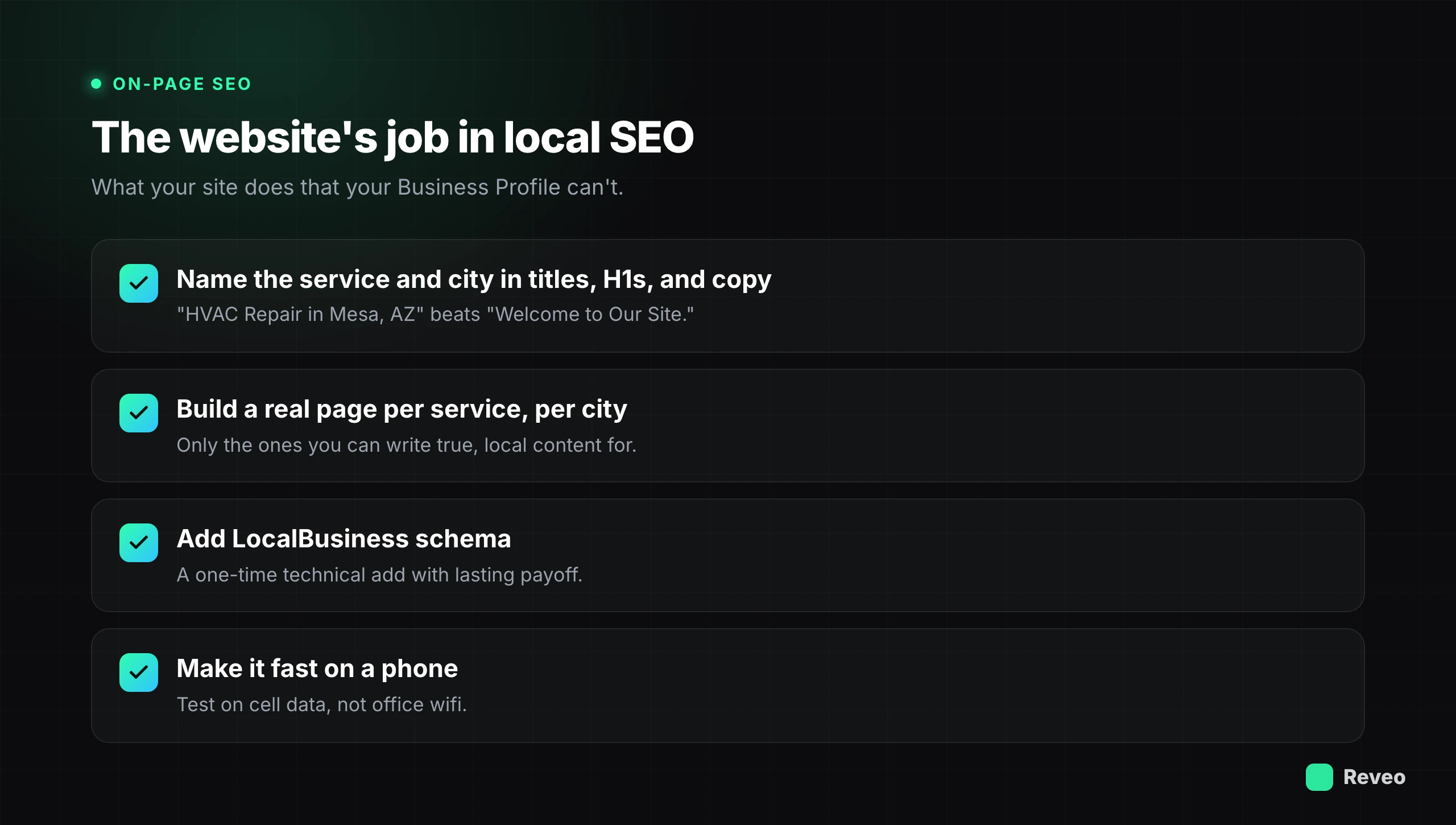
- Name the service and the city in your titles, H1s, and copy. “HVAC Repair in Mesa, AZ” beats “Welcome to Our Site” every time. Write for how people actually search — the service plus the place. Not sure which service-and-city terms you’re actually missing? Run the free keyword gap finder.
- Build a page per service, per city. “Pest Control in Mesa” and “Pest Control in Scottsdale” should be two real pages with genuinely local content, not one page with the city swapped by a script. Thin, duplicated location pages are a known way to hurt rankings, so only build the ones you can write something true about.
- Add LocalBusiness schema. This structured markup tells search engines your business type, address, hours, and service area in a format they trust. It’s a one-time technical add with lasting payoff.
- Make it fast on a phone. Most local searches happen on mobile, and a slow site loses both the visitor and the ranking. Check your real Google PageSpeed score instead of guessing from your own connection.
Don’t over-invest here before your GBP and reviews are handled. For most home-service businesses, a clean site with honest service-and-city pages beats an elaborate one — and the map pack will send you calls long before your blog does.
Citations and NAP consistency
Here’s the full checklist for this section if you want to work through it directly. A citation is any mention of your business Name, Address, and Phone number on another site — directories like Angi, Houzz, Thumbtack, and HomeAdvisor, plus data aggregators and local listings. They matter because Google cross-checks them to confirm you’re a real, established business, and inconsistency quietly erodes that trust.
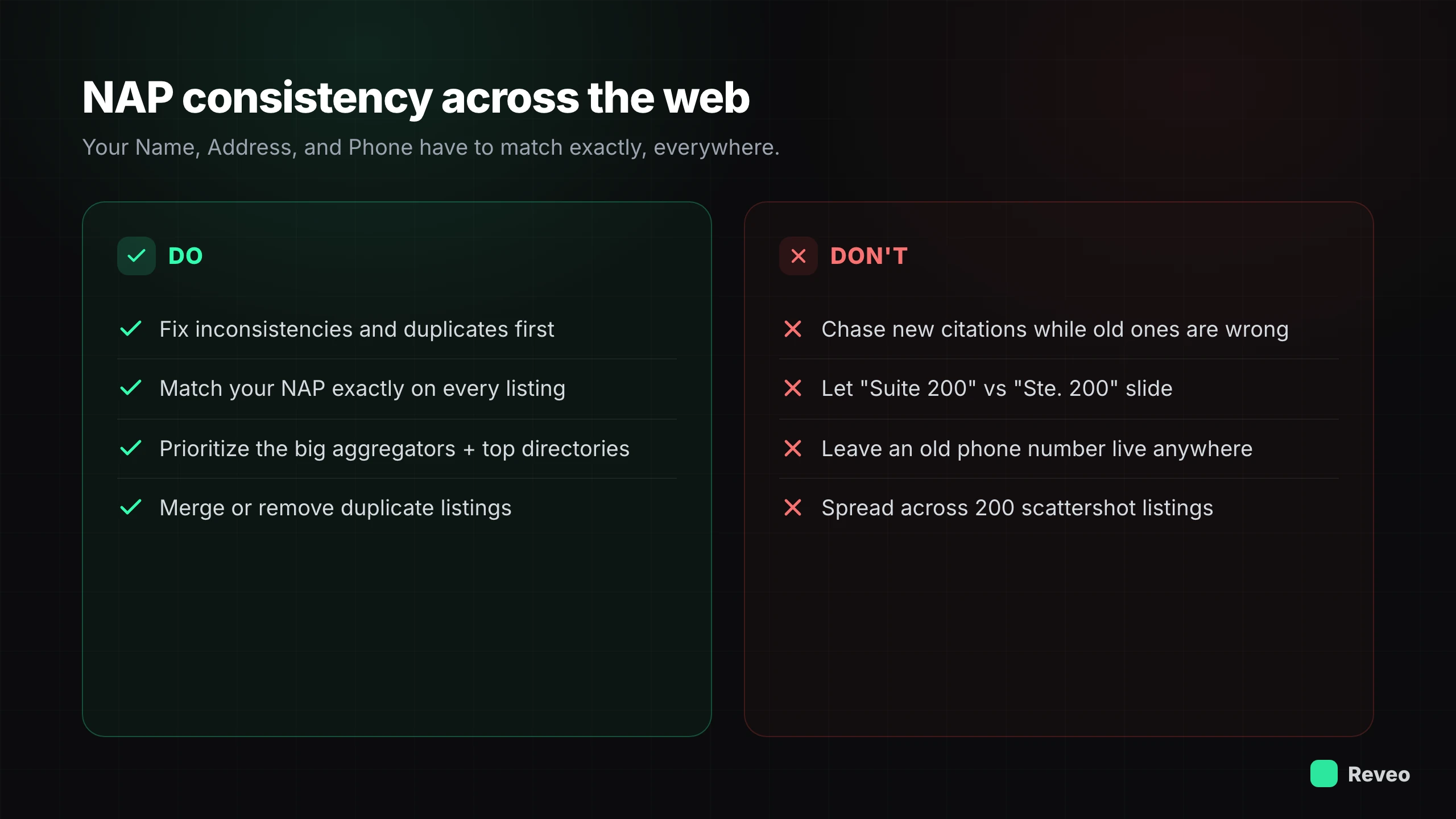
The rule is boring and absolute: your NAP has to match exactly, everywhere. “Suite 200” in one place and “Ste. 200” in another, an old phone number on a directory you forgot about, a listing under a former business name — each one is a small vote against your legitimacy. The two moves that matter:
- Fix the inconsistencies and duplicates first. Chasing new citations while old wrong ones are live is filling a leaky bucket. Audit what’s out there, correct the NAP, and merge or remove duplicate listings.
- Prioritize the directories that count. The big aggregators and the top directories in your industry carry far more weight than obscure ones. A handful of high-authority, perfectly consistent citations beats 200 scattershot listings.
Keeping this straight across the major directories by hand is where owners give up. Our free listings management guide has the 20-directory priority list and the audit method to work through it yourself.
Where to start this month
You don’t need an agency. You need these in order, because each one compounds the next:
- Complete your Google Business Profile — every category, service, service area, hours, and a batch of real photos. This is the fastest ranking you’ll gain.
- Turn on automatic review requests for every completed job, sent by text within the hour, wired to your field software (FieldRoutes, ServiceTitan, Jobber, Housecall Pro) so no one has to remember.
- Fix your NAP across the top directories and kill the duplicates.
- Write honest service-and-city pages on your site for the work and markets you actually serve, and add LocalBusiness schema.
- Respond to every review you haven’t answered, starting with the negative ones.
Reviews are the lever that keeps moving after the setup work is done, and they’re the one most companies leave on the table. Reveo automates the whole loop — request, response, and promotion — so the review signal Google weighs most keeps feeding your ranking on its own. That’s the same compounding that turned EcoStar’s and Romney’s review counts into a durable spot at the top of the map.
Want to see where you stand today? Run a free local visibility scan for a snapshot of your Google Business Profile, reviews, and listings in a couple of minutes.