

Google Business Profile optimization is the work of making your free Google listing complete, active, and review-rich enough that you show up in the local map pack — and that the people who see you there call instead of scrolling to a competitor. For a home-service business, your profile is usually the first thing a customer sees when they search “plumber near me” or “AC repair” at 9pm with a flooded basement, and it decides the call before they ever read your website.
Most owners claim and verify the profile and stop there. That’s the gap. A claimed-but-neglected profile ranks below one that’s fully filled out, posts weekly, and pulls in fresh reviews — even when the neglected business does better work. This guide is the whole playbook: what to fill in, what actually moves ranking, and what to ignore.
What Google Business Profile optimization actually is
Your Google Business Profile is the panel that appears when someone searches your name or your service in Google Search and Maps — the one with your hours, photos, reviews, and the “Call” and “Directions” buttons. Optimizing it means two things at once: getting found (ranking in the local pack) and getting chosen (converting the view into a call or a booked job).
Those are different problems. A profile can rank well and still convert badly because the photos are three years old and there are eight reviews. Another can be gorgeous and never show up because the categories are wrong and nobody’s asked a customer for a review in months. You need both, and reviews are the thread that runs through them — which is why reputation and local SEO are really the same project.
Why it’s worth the hour
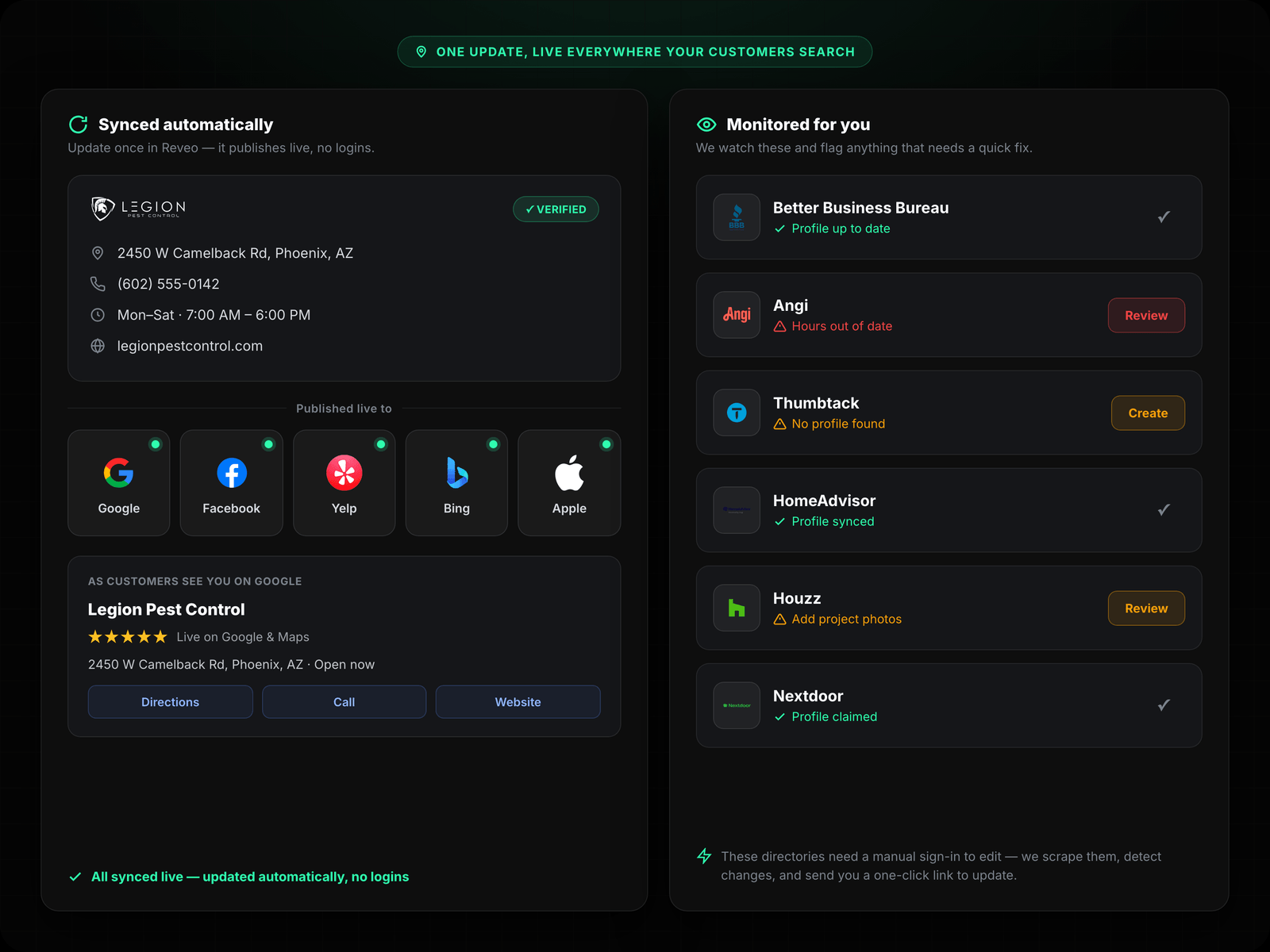
Google doesn’t publish a ranking formula, but the pattern is consistent across every independent study and everything we see managing profiles for home-service companies: the local map pack is driven mostly by relevance (do your categories and services match the search), proximity (how close you are), and prominence — and prominence is largely reviews. Moz’s long-running Local Search Ranking Factors survey has put Google Business Profile signals, review signals chief among them, at the top of the local-pack list for years.
Here’s what that looks like when a company actually commits to it:
- EcoStar Pest Control built 1,015 Google reviews from a single location — the kind of density you usually only see from a regional chain. Owner Pete Updike notes most pest companies in his area sit at 50 to 200 reviews, so customers click EcoStar first.
- Romney Pest Control collected 2,337 reviews across three locations, and when the founder sold the company, that review density directly influenced the valuation. Reputation showed up on the balance sheet.
- Legion Pest Control reached 994 reviews in 24 months and stopped babysitting it — the requests go out on their own after each job.
None of those came from an ad budget. They came from a profile that stays active and a review request that fires on every job. That’s the whole game.
The core optimization steps
Do these in order. The first four matter more than the rest combined.
1. Fill in every field — no blanks. Business name (your real name, no keyword stuffing — Google will suspend you for it), primary category, secondary categories, service area, hours, attributes, and a real business description. A complete profile outranks a partial one, and completeness is the cheapest win here. If your description is still the default boilerplate or something rushed at signup, Reveo’s free AI bio rewriter turns it into real copy in under a minute.
2. Nail your primary category. This is the single highest-impact field and the one most owners get wrong. The primary category carries the most ranking weight, so pick the exact one your best customers would search — “Pest control service,” not “Service establishment.” Add secondaries for everything else you do. A wrong primary category can keep you out of the pack entirely no matter how many reviews you have.
3. Add photos, and keep adding them. Real photos of your trucks, your crew, and finished jobs — not stock. Businesses with more photos tend to earn more views, clicks, and direction requests, and that engagement feeds ranking. You don’t need a photographer; you need a habit. Have techs snap one clean “after” shot per job and upload a batch weekly. Not sure if what’s up there is actually working for you? Run a free trust audit — upload a screenshot and get an honest read on what a stranger notices first.
4. Collect and respond to reviews — relentlessly. This is the engine. Reviews are one of the strongest local ranking factors, and Google weighs quantity, rating, recency, and whether you reply. The way you get from 40 reviews to 400 isn’t asking better — it’s asking every time, right after the job, by text. More on the mechanics below, and here’s the full review management playbook if you want to go deeper.
5. Post weekly. Google Posts — an offer, a seasonal reminder, a job highlight — signal that the business is alive. They won’t rocket you up the pack, but a profile that posts looks active next to a competitor whose last update was 2023, and that shows up in whether people choose you.
6. Turn on messaging and booking. Every extra step between “I found you” and “I contacted you” costs jobs. Let people message or book straight from the profile.
Reviews are where profiles are won or lost
If you only fix one thing, fix your review flow. A steady stream of recent five-star reviews does double duty: it convinces the person reading, and it tells Google you’re an active, trusted business worth ranking. A profile with 12 reviews from last year loses to one with 300 and a new one this week, every time.
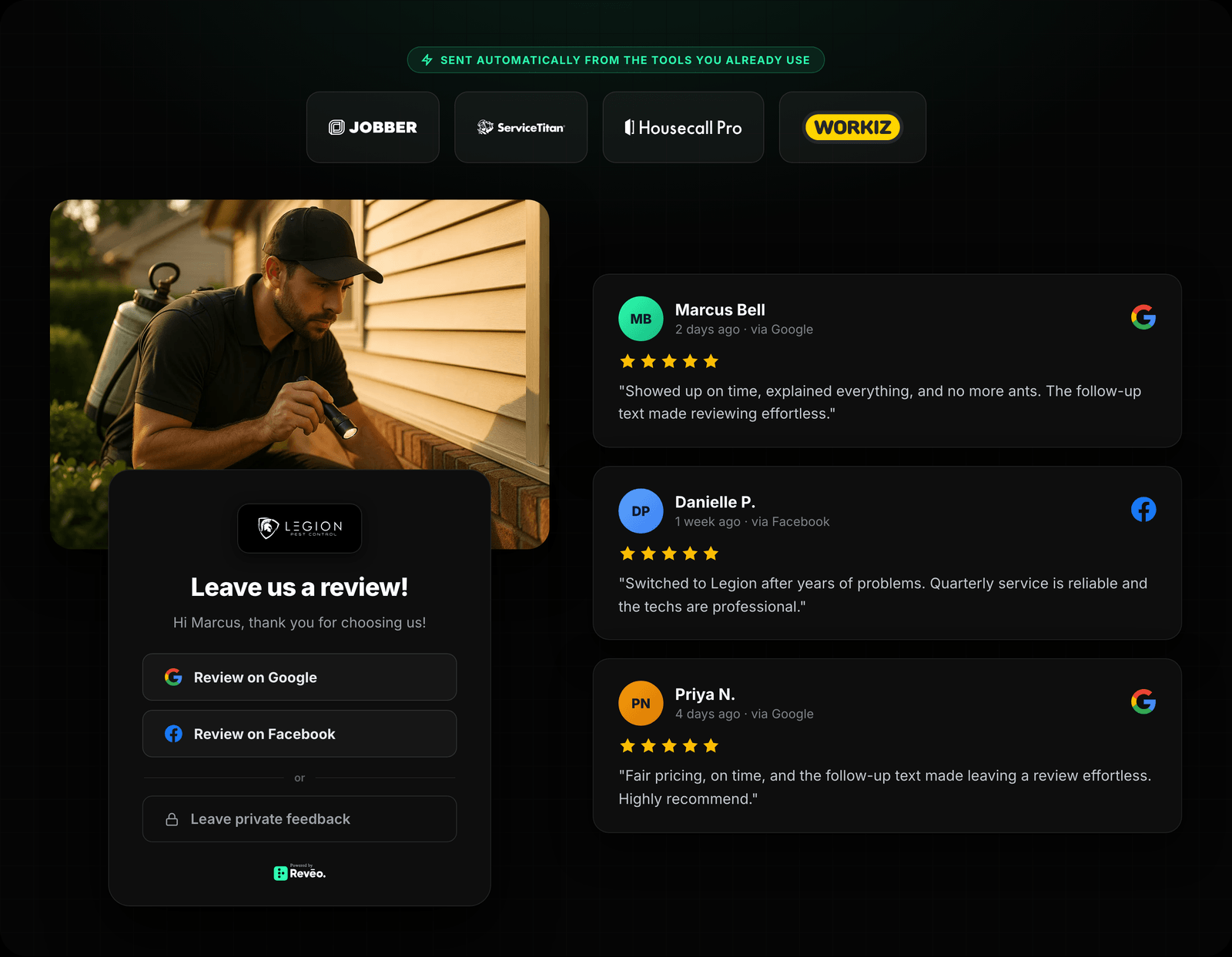
The reason most home-service businesses are stuck at 40 reviews isn’t effort — it’s memory. The tech finishes, gets in the truck, and the ask never happens. The fix is to take the person out of the loop entirely: wire the review request to fire automatically when a job is marked complete in your field software — FieldRoutes, ServiceTitan, Jobber, Housecall Pro — so the text goes out while the customer is still standing in a fixed-up house.
That timing is most of the battle. A request sent within the hour converts far better than one sent the next day, and text beats email badly for home services. Make the link one tap to the Google review box; every extra step loses people. And respond to what comes in — a reply to a five-star takes thirty seconds, and a calm reply to a one-star is really an ad to every future customer reading it. When a bad one lands, respond fast and take it offline — velocity from the good ones dilutes it anyway. Two reviews are worth handling differently, not diluting: a fake or spam review that violates Google’s policies should be flagged for removal, not responded to, and if Google ever removes a real review by mistake, there’s a specific process to get it restored.
Automation, without the babysitting

The best-performing profiles aren’t managed by hand. There’s too much to keep up with weekly — requests, replies, posts, listing accuracy across directories — and it’s exactly the work that slips first when you’re busy running crews.
This is where Reveo does the heavy lifting. It fires the review request automatically after every completed job (SMS and email), pulls your Google reviews into one inbox, and drafts replies you can send in a couple of taps so responding to everything takes minutes, not an afternoon — and flags a new negative review the same day it lands instead of the next week.
The point isn’t a fancier dashboard. It’s that the review engine, the part that actually drives your ranking, runs whether or not anyone remembers to run it. Running more than one location? The same playbook applies per profile, but multi-location and franchise ownership add access and structure questions worth getting right before you scale it.
Keep it alive
Optimization isn’t a one-time task — the profiles that rank highest are the ones that stay accurate and active. A short monthly rhythm holds it:
- Check NAP consistency. Name, address, and phone must match exactly everywhere. Small mismatches confuse Google and cost ranking.
- Update seasonally. Holiday hours, seasonal services, current promotions. A profile with wrong hours costs you the call and the trust.
- Watch the metrics that matter. Profile views, calls, direction requests, and website clicks. A sudden dip usually means a listing change or a competitor’s review surge — spot it early.
That’s the maintenance loop. Fifteen minutes a month once the review engine is automated.
Start this week
You don’t need a project. Three moves:
- Fix your categories and fill every blank field — primary category first.
- Turn on automatic review requests for every completed job, sent by text within the hour, and reply to every review you’ve ignored.
- Upload a batch of real photos of your crew and recent work, and schedule a Google Post.
Want the full field-by-field version? Download the free GBP optimization checklist — 27 fixes, in the order that actually moves rankings.
Do those consistently and your ranking, your review count, and your call volume start moving in the same direction — the same compounding that turned EcoStar’s and Romney’s review counts into a real competitive edge.
Want to see where your profile stands right now? Run a free reputation scan for a snapshot of your reviews, rating, and listings in about two minutes.