


Most Google Business Profile tools market themselves as all-in-one, but they split into two camps: tools that manage the profile itself — listings, NAP consistency, GBP posts, rank tracking — and tools that pull reviews into it. Knowing which camp you actually need is what keeps you from paying $300 a month for features a five-truck shop will never open.
This roundup is about the first camp: GBP tools that manage and optimize the profile Google shows a homeowner before they call you. If your bigger question is the wider review-and-messaging stack — who generates reviews, who handles the inbox, who runs surveys — read our reputation management tools comparison instead. Here we stay on the profile.
What a GBP tool is actually for
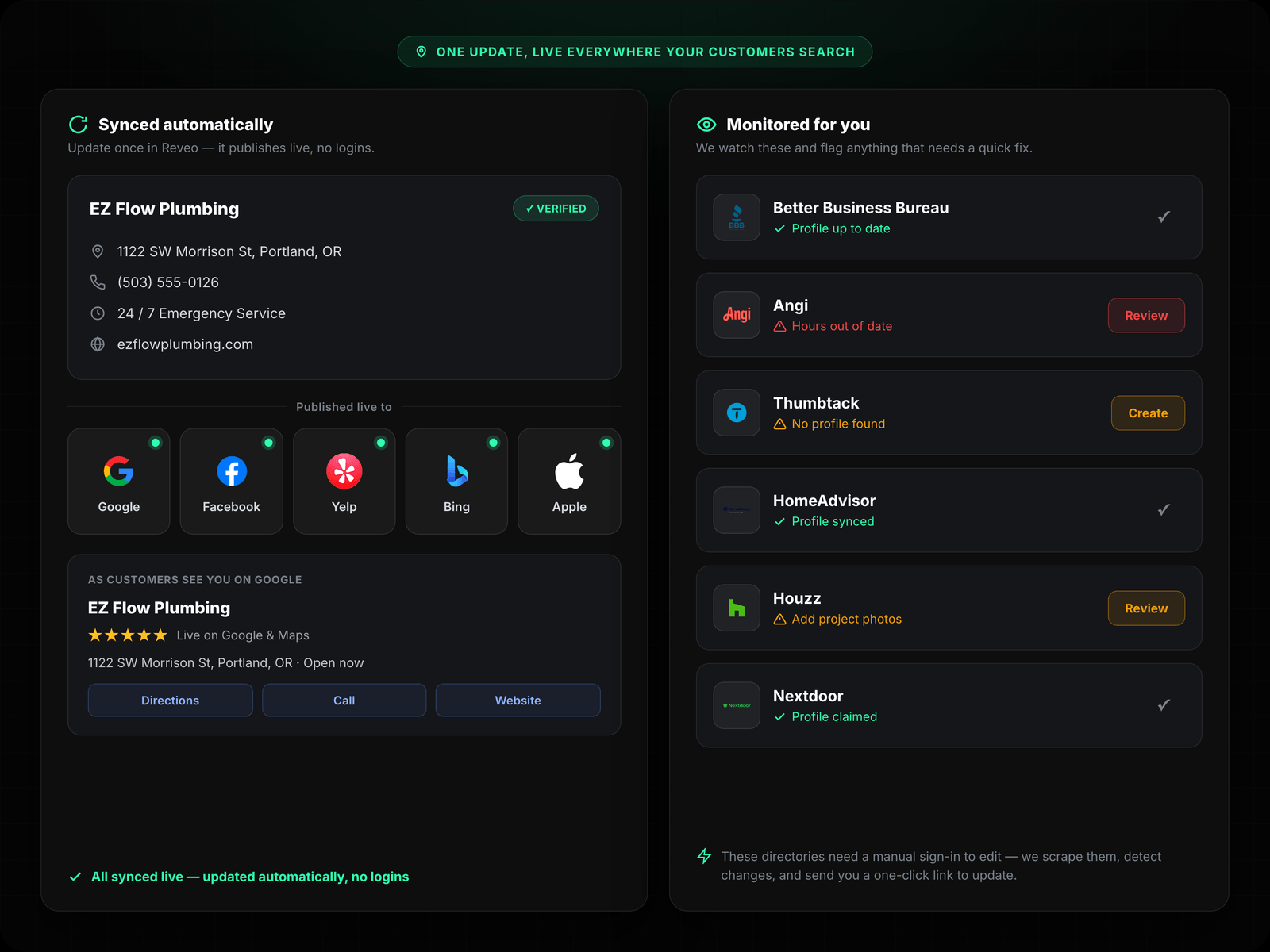
Your Business Profile is the panel that decides whether a nearby homeowner calls you or the company one spot above you: the star rating, the recent reviews, the hours, the photos, the “call” button. A GBP tool exists to keep that panel accurate, active, and ahead of competitors without you logging into Google every morning.
Four jobs separate a real GBP tool from a widget:
- Listing accuracy (NAP sync). Your name, address, and phone kept identical across Google, Bing, Apple Maps, Facebook, and the industry directories. Drift here quietly costs you local ranking.
- GBP posts. Offers, updates, and events published to the profile on a schedule so it reads as active — a freshness signal Google rewards.
- Reviews on the profile. Requesting, monitoring, and replying to the Google reviews that dominate the panel. This is where most home-service ranking is won or lost.
- Rank and insights. Tracking where you show up in the local map pack for the searches that matter, plus the calls and clicks the profile drives.
No single tool below is best at all four. That is the real decision — which two or three matter most for how you operate.
Google’s own guidance is blunt about why this work pays: it reports that customers are 70% more likely to visit and 50% more likely to consider a purchase from a business with a complete, active profile. Completeness and activity are exactly what these tools automate.
Quick comparison

Seven tools home-service operators actually shortlist, scored on the GBP-specific jobs above. Starting prices are public list prices as of early 2026; enterprise tools scale by location and usually require an annual contract, so treat these as floors.
| Tool | Best for | Starting price | Reviews | Listings sync | GBP posts | AI responses | Rank tracking |
|---|---|---|---|---|---|---|---|
| Reveo | Home services | Free trial | ✓ | ✓ | ✓ | ✓ | — |
| Birdeye | Enterprise / multi-location | $299+/mo | ✓ | ✓ | ✓ | ✓ | Limited |
| Podium | SMS-first teams | $399+/mo | ✓ | — | — | Limited | — |
| Yext | Listings at scale | $199+/yr | Limited | ✓ | — | — | — |
| BrightLocal | Local SEO tracking | $39+/mo | Limited | ✓ | — | — | ✓ |
| Whitespark | Citations | $20+/mo | — | ✓ | — | — | ✓ |
| Kenect | Business texting | $549/mo | ✓ | — | — | — | — |
The tools, by what they actually do for your profile

Reveo — best for home-service operators
Reveo is built for one outcome: keeping a pest-control, HVAC, plumbing, or lawn-care profile stacked with recent reviews and active posts without adding work for the crew. Review requests fire the moment a job is marked complete in FieldRoutes, ServiceTitan, Jobber, or Housecall Pro, so the text lands within the hour — when response rates are highest — instead of the next day. AI drafts each reply in your voice for one-click approval, GBP posts and listing details run from the same dashboard, and there is no annual contract to sign to find out the price.
What it doesn’t do: dedicated local-rank tracking. If your job is watching map-pack positions across dozens of keywords, pair Reveo with a tracker like BrightLocal. For most single- and multi-location service shops, the reviews-and-posts engine is where the ranking actually comes from.
Birdeye — best for multi-location enterprises
Birdeye covers the whole profile — reviews, listing sync, GBP posts, AI responses, plus social and web chat — which is why regional and national brands run it. The catch is the same as always: pricing starts around $299/mo per location on an annual contract, and the interface carries features a small team will never open. It’s more platform than a five-truck shop needs.
Podium — best for SMS-first teams
Podium’s profile work is really review collection by text, and it’s good at it. What’s missing for GBP specifically is the rest of the panel: no listing sync, no GBP post scheduling, and AI responses that trail dedicated tools. At $399+/mo you’re paying a premium for the texting layer and covering the profile’s other jobs elsewhere.
Yext — best for listings at scale
Yext pioneered listing sync and still sets the standard for pushing accurate business data across 100+ directories. If NAP consistency across dozens of locations is your headache, it delivers. But its review management is thin and it doesn’t do GBP posts or AI responses, so it handles one of the four jobs well and leaves you to source the others. Pricing is annual, starting around $199/year and climbing fast at enterprise tiers.
BrightLocal — best for tracking, not managing
BrightLocal is the analyst of this group: local-rank tracking, citation audits, and GBP insight reports done well and cheaply at $39+/mo. It tells you where you stand — it won’t send review requests, reply for you, or schedule posts. Treat it as the measurement layer alongside a tool that does the managing, not a replacement for one.
Whitespark — best for citations
Whitespark specializes in finding and fixing local citations, with a well-regarded Citation Finder and rank tracker. At $20+/mo it’s the budget pick when your specific problem is inconsistent or missing listings. It doesn’t touch reviews, posts, or AI, so it’s a precision tool for one job, not a profile manager.
Kenect — worth knowing, narrow fit
Kenect is a business-texting platform with review collection added on. Two-way SMS is its strength; there’s no listing sync, GBP posts, or AI responses, and at $549/mo it’s the priciest tool here for the narrowest slice of the profile. Fits a shop that mainly wants a texting line and treats reviews as a bonus.
Which of the four jobs is yours?
Skip the feature spreadsheet and name the profile job you’re actually behind on:
- You’re behind on reviews. This is most home-service shops, and it’s the job with the biggest ranking payoff. You need automated requests tied to your field software and AI-assisted replies — a reviews-first platform like Reveo, not a listings tracker.
- Your listings are a mess. Wrong hours, duplicate profiles, mismatched phone numbers across directories. Start with a listing-sync tool (Yext at scale, Whitespark on a budget) and fix the data before anything else.
- You want to know where you rank. Map-pack visibility across keywords and locations is a tracking problem — BrightLocal is the cheap, focused answer, run alongside whatever manages the profile.
- You need the whole panel handled. Reviews, posts, listings, and replies from one screen without a marketing hire — that’s the all-in-one case, and where a home-service-built platform earns its keep.
The trap is buying an enterprise suite to solve job #1. A shop that needs recent reviews doesn’t need a $300/mo multi-brand dashboard; it needs the request to fire automatically after every job. That single mechanic — not the length of the feature list — is what turned EcoStar’s single location into 1,015 reviews and moved Romney Pest Control’s sale valuation. None of it came from an ad budget; it came from asking every customer, every job, without fail.
Once the tool is picked, the GBP optimization guide covers how to actually work the profile week to week.
Want to see where your profile stands before you buy anything? Run a free reputation scan — it pulls your current reviews, rating, and listing accuracy into a two-minute snapshot, no sales call attached.