


The reputation software you pick decides one thing above all: whether asking every customer for a review happens automatically, or gets left to whoever remembers. That is the difference between the home-service companies sitting at 40 reviews and the ones we’ve watched cross 1,000, so this is a straight comparison of the reputation management tools worth your money — what each one actually does, what it costs, and who it fits.
Reputation management software is broader than a single review widget. The right platform generates reviews after every job, monitors what customers say across Google, Facebook, Yelp, and the rest, drafts on-brand responses, and rolls messaging and surveys into one screen. If your only concern is your Google Business Profile specifically — posts, listing sync, citations — start with our roundup of GBP-specific optimization tools; this guide covers the wider review-and-reputation stack.
What actually separates these tools
Feature checklists all look the same on a sales page. Two things really decide whether a reputation tool earns its price:
Does the review request fire on its own? The single biggest predictor of review volume isn’t a better message — it’s whether the ask goes out automatically the moment a job closes, by text, while the customer is still standing in a cool house or a clean kitchen. A tool that makes your techs remember to send the link will lose to one that fires it from your field software every time. That is the mechanic behind review management that compounds instead of stalling.
How much are you paying for features you’ll never touch? Enterprise suites bundle social publishing, competitor benchmarking, and multi-brand dashboards a five-truck HVAC shop will never open — and charge $300–$500+/mo for the privilege, usually on an annual contract. A single-location operator is better served by a focused, month-to-month tool than by a platform built for a 400-location chain.
Keep those two questions in mind as you read the table below.
Quick comparison
Nine platforms home-service operators actually shortlist, scored on the features that move review volume. Starting prices are public list prices as of early 2026; most enterprise tools scale by location and require an annual contract, so treat these as floors, not quotes.
| Tool | Best for | Starting price | Review generation | Messaging | Listings | Surveys | AI responses |
|---|---|---|---|---|---|---|---|
| Reveo | Home services | Free trial | ✓ | ✓ | ✓ | ✓ | ✓ |
| Birdeye | Multi-location / enterprise | $299+/mo | ✓ | ✓ | ✓ | ✓ | ✓ |
| Podium | SMS-first teams | $399+/mo | ✓ | ✓ | — | — | Limited |
| Reputation.com | 1,000+ location brands | Custom | ✓ | Limited | ✓ | ✓ | ✓ |
| NiceJob | Budget review generation | $75+/mo | ✓ | — | — | — | — |
| GatherUp | Agencies + multi-location | $99+/mo | ✓ | Limited | Limited | ✓ (NPS) | Limited |
| Grade.us | Agency white-label | $110+/mo | ✓ | — | Limited | — | — |
| Kenect | Business texting | $549/mo | ✓ | ✓ | — | — | — |
| BrightLocal | Local SEO + monitoring | $39+/mo | Limited | — | ✓ | — | — |
The tools, reviewed
Reveo — best for home-service operators
Reveo is built for one job: getting home-service companies — pest control, HVAC, plumbing, lawn care, roofing — more reviews without adding work for the crew. Review requests fire automatically the moment a job is marked complete in FieldRoutes, ServiceTitan, Jobber, or Housecall Pro, so the text lands within the hour instead of the next day, which is when response rates fall off a cliff. AI drafts each reply in your voice for one-click approval, and reviews, messaging, listings, and surveys live on one screen instead of four subscriptions.
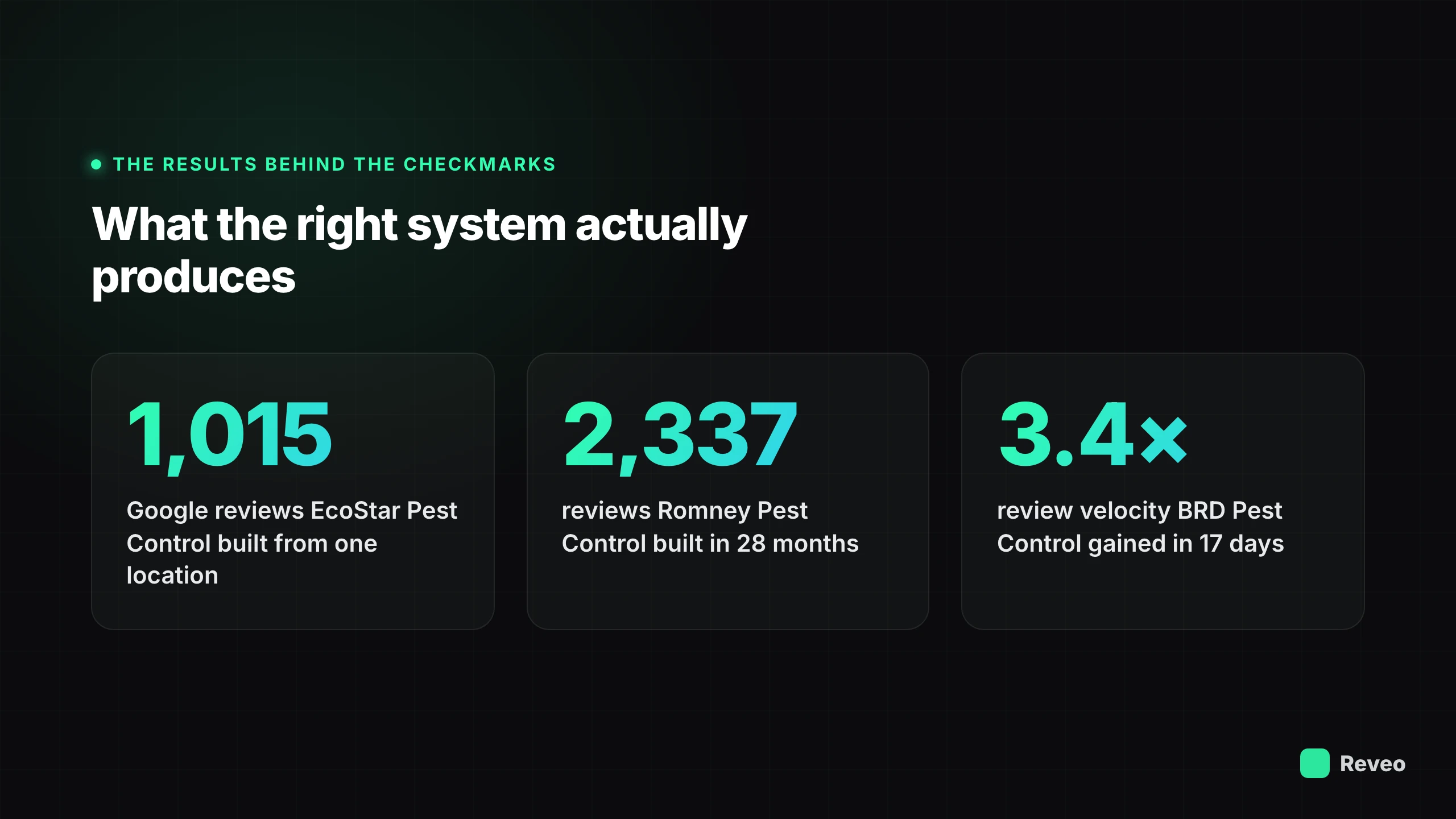
The proof is in customer numbers we can point to: EcoStar Pest Control built 1,015 Google reviews from a single location, Romney Pest Control reached 2,337 reviews in 28 months, and BRD Pest Control gained 3.4× its review velocity in the first 17 days. None of that came from an ad budget — it came from asking every customer, every job, automatically.
Trade-off to know: Reveo is a newer brand with less name recognition than the enterprise players, and the home-service focus means it’s a poor fit for retail or hospitality. If you run trucks and crews, that focus is the point; if you don’t, look elsewhere.
Birdeye — best for multi-location enterprises
Birdeye is the broadest platform on this list — reviews, messaging, listings, surveys, social publishing, and web chat across dozens of industries. Multi-location management and reporting are genuinely strong, which is why big regional and national brands run it.
That breadth is also the catch. Pricing starts around $299/mo per location, typically on an annual contract, and the interface carries features a small team will never open. For a single-location operator without a dedicated marketing person, it’s more platform than the job requires.
Podium — best for SMS-first teams
Podium built its name on text. Review invitations, a unified customer inbox, payments, and web chat all run through SMS, and the review-collection-by-text flow is genuinely good. If your whole customer relationship already lives in text messages, it fits how you work.
The gaps show up fast, though: no listings management, no surveys, and AI responses that lag dedicated reputation tools. At $399+/mo it’s the priciest mainstream option here, so you’re paying a premium for the texting layer and covering the rest with other tools.
NiceJob — best for budget review generation
NiceJob does one thing and does it cleanly: automated review request sequences plus website widgets that show off the reviews you collect. Setup is simple, it’s affordable at around $75/mo, and for a shop that only needs to turn happy customers into Google reviews, that’s often enough.
Its ceiling is real. There’s no messaging, no listings sync, no surveys, and no AI responses — so as you start juggling reviews across platforms and want replies handled for you, you’ll outgrow it. Good starter, not a long-term home.
GatherUp — best for agencies and multi-location
GatherUp pairs review generation with built-in NPS surveys and solid reporting, and its white-label options make it a favorite with marketing agencies managing reviews for a roster of clients. If you want first-party feedback data alongside public reviews, that survey layer is a real edge.
Messaging and listings are present but thin, and the AI response tooling is basic next to purpose-built reputation platforms. It sits in the middle — more than a review-only tool, less than a full all-in-one.
Reputation.com — best for 1,000+ location brands
Reputation.com is one of the original enterprise players, built for brands running hundreds or thousands of locations. The full suite is here — reviews, listings, surveys, AI, social — with deep analytics and competitive benchmarking that genuinely earn their keep at scale.
At that scale is the operative phrase. Pricing is custom and lands in enterprise territory, onboarding is long, and it generally needs a dedicated admin to run. For a home-service company under a few dozen locations, it’s overkill.
Grade.us — best for agency white-label
Grade.us is built for the agency reselling review management, not the operator running one business. It handles multi-step review funnels, drip campaigns, and white-labeled client reporting well, and priced around $110/mo it’s a reasonable base for an agency’s service line.
As an end operator, you’ll feel what’s missing: no unified messaging, no surveys, only light listings support. Unless you’re managing reviews on behalf of other businesses, a tool built for the operator will serve you better.
Also worth knowing
- Kenect — a business-texting platform with review collection bolted on. Two-way SMS is its strength; there’s no listings, surveys, or AI responses, and at $549/mo it’s the most expensive tool here for the narrowest feature set. Best if you primarily want a texting line and treat reviews as a bonus.
- BrightLocal — a local-SEO and citation-monitoring tool, not an automation platform. It tracks rankings, monitors citation accuracy, and surfaces reviews across sites, but it won’t send requests or reply for you. Think complement to a reputation tool, not a replacement — and at $39+/mo, a cheap one.
The five features that actually matter
Every tool lists a dozen capabilities. These five decide whether it moves the needle for a home-service business:
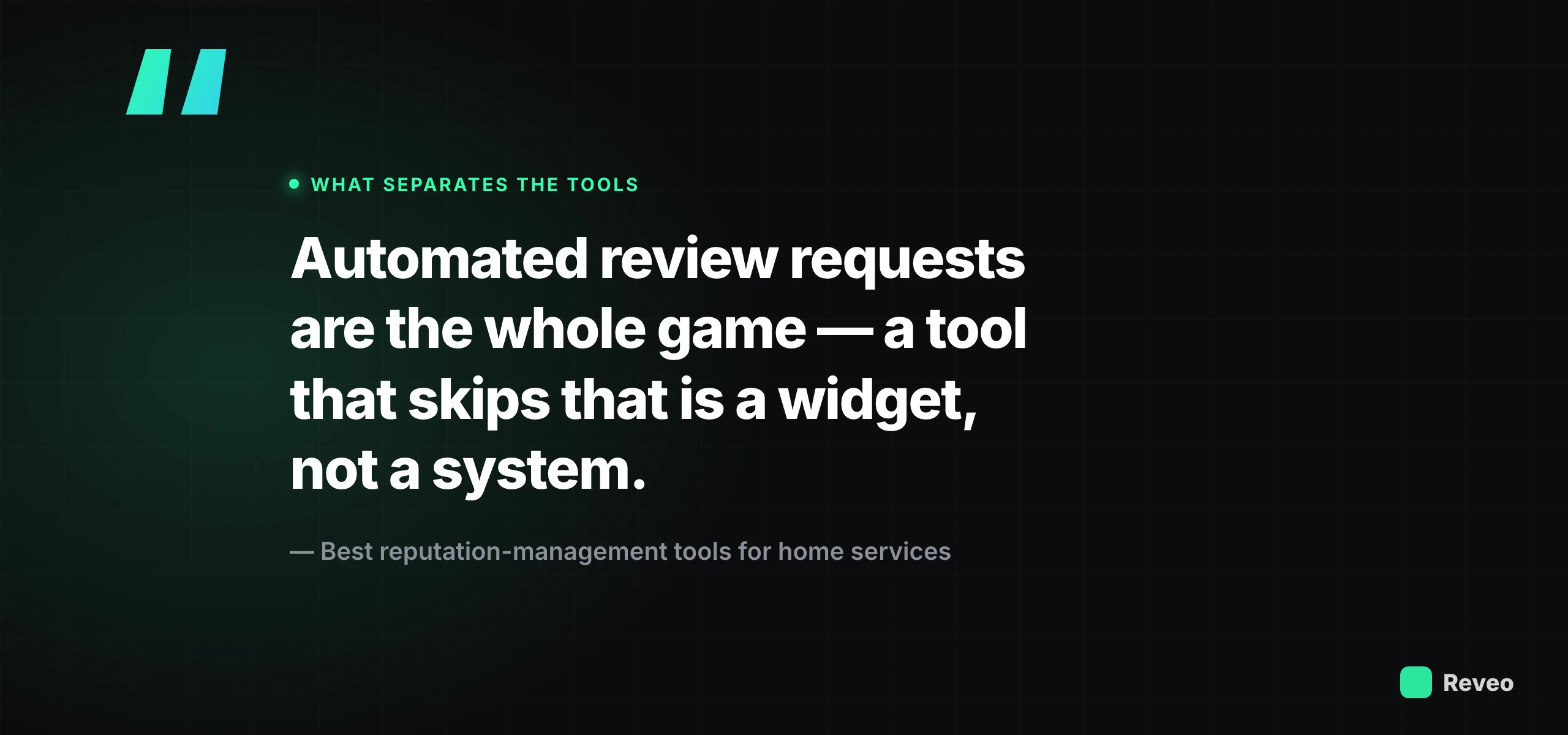
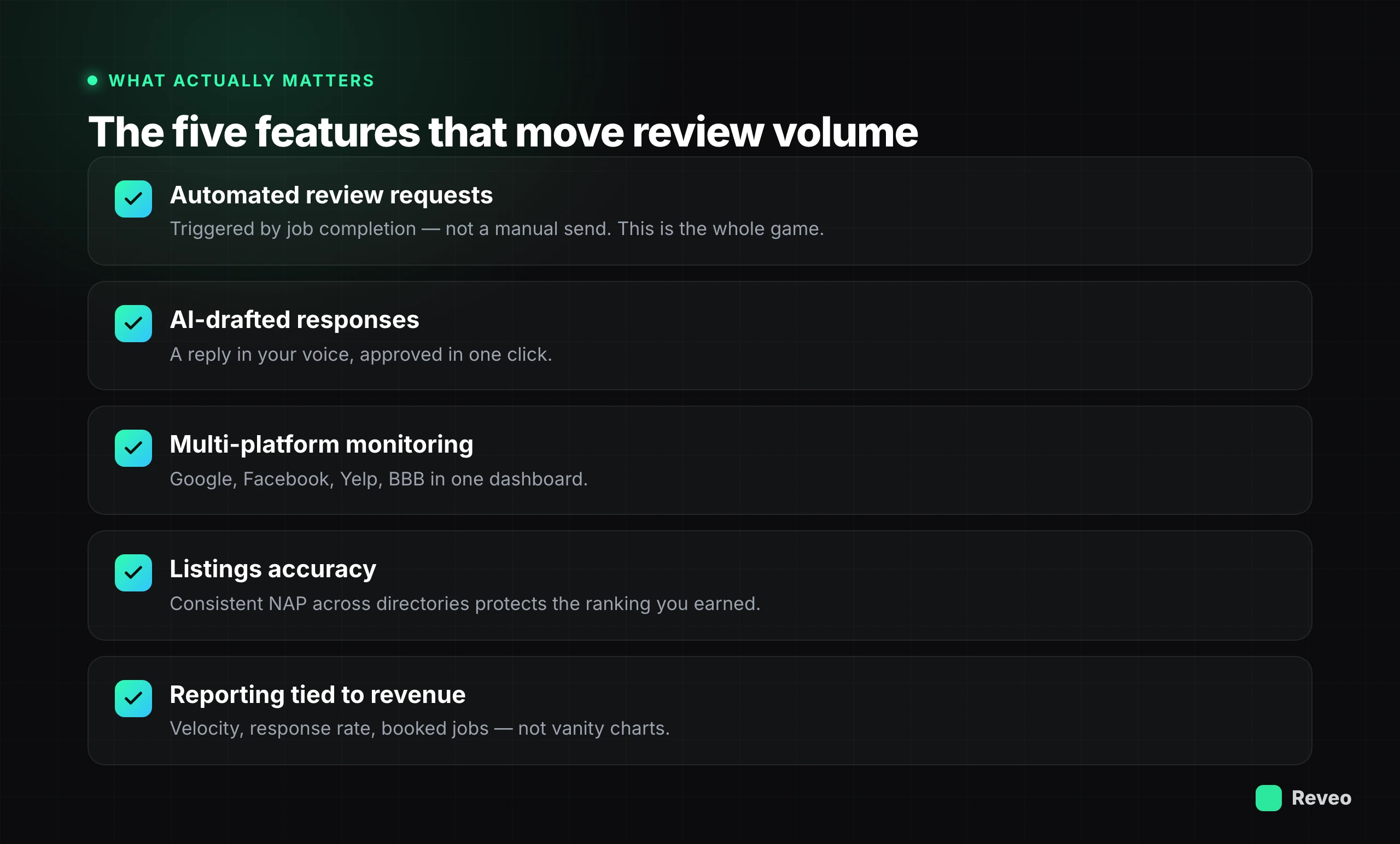
Automated review requests. Triggered by job completion in your field software — not a manual send. This is the whole game; a tool that skips it is a widget, not a system.
AI-drafted responses. Every review gets a reply in your voice, drafted for you and approved in one click. Fast, consistent responses are a documented local-ranking signal and a trust cue for the next reader.
Multi-platform monitoring. Reviews pulled from Google, Facebook, Yelp, BBB, and the rest into one dashboard, so you’re not logging into five sites to find out what people are saying.
Listings accuracy. Consistent name, address, and phone across directories. Drift quietly costs you local ranking; a tool that keeps it clean protects visibility you already earned.
Reporting tied to revenue. Review velocity, response rate, star-rating trend, and — the one that matters to an owner — how it connects to calls and booked jobs. Numbers you can show, not vanity charts.
How Reveo compares
Most tools on this list were built for businesses in general, then stretched to fit service companies. Reveo runs the other direction — every feature is designed around how a pest-control, HVAC, plumbing, or lawn-care company actually operates.
That shows up in three concrete places. Review requests fire from FieldRoutes and ServiceTitan the moment a job closes, so timing is never left to a busy tech. Reviews, messaging, listings, and surveys sit in one dashboard instead of three or four subscriptions you stitch together with Zapier. And pricing is month-to-month with a free trial — no annual contract, no sales call to see a number. If you’re deciding between platforms, that combination of field-service timing, one screen, and no lock-in is the shortlist argument.
How to actually decide
Skip the 14-tab spreadsheet. Three moves get you to a confident pick:
- Name your must-have. Review generation only? A focused tool like NiceJob is enough. Reviews plus messaging, listings, and surveys in one place? That points to an all-in-one.
- Shortlist three, not ten. Use the table above to pick the platforms that match your budget and your feature floor, then ignore the rest.
- Run each on real customers. A free trial on this week’s completed jobs tells you more than any demo. Watch how fast requests go out and how many convert.
When you’re ready to see where your reputation stands today, run a free reputation scan — it pulls your current reviews, rating, and listing accuracy into a two-minute snapshot, no sales call attached.