


The digital age has fundamentally transformed consumer behavior. The modern consumer journey begins online long before a purchase is ever made, and every digital touchpoint shapes how a business is perceived. In this landscape, online reviews serve as digital word-of-mouth, wielding enormous influence over purchasing decisions and ultimately determining which businesses thrive and which fall behind.
This guide explores the full scope of how reviews and reputation management impact business growth — from the psychology of consumer trust to the mechanics of SEO, from reactive damage control to proactive strategy, and from today’s best practices to tomorrow’s emerging trends.
1. The Digital Consumer Journey
Before a customer walks through your door, picks up the phone, or clicks “buy,” they’ve already been on a journey. They’ve searched, compared, read, and judged. The modern consumer journey is overwhelmingly digital, and online reviews sit at the most critical inflection points along the way.
Consider the typical path: a consumer identifies a need, searches Google or asks a friend, discovers a shortlist of options, and then seeks validation. That validation almost always comes from reviews. They aren’t just reading your marketing copy — they’re reading what real people have to say about their experience with your business.
Every digital touchpoint — your Google Business Profile, Yelp listing, Facebook page, and industry-specific platforms — shapes perception. And the businesses that understand this journey and actively manage these touchpoints are the ones that capture the most customers.
2. The Dominance of Online Reviews
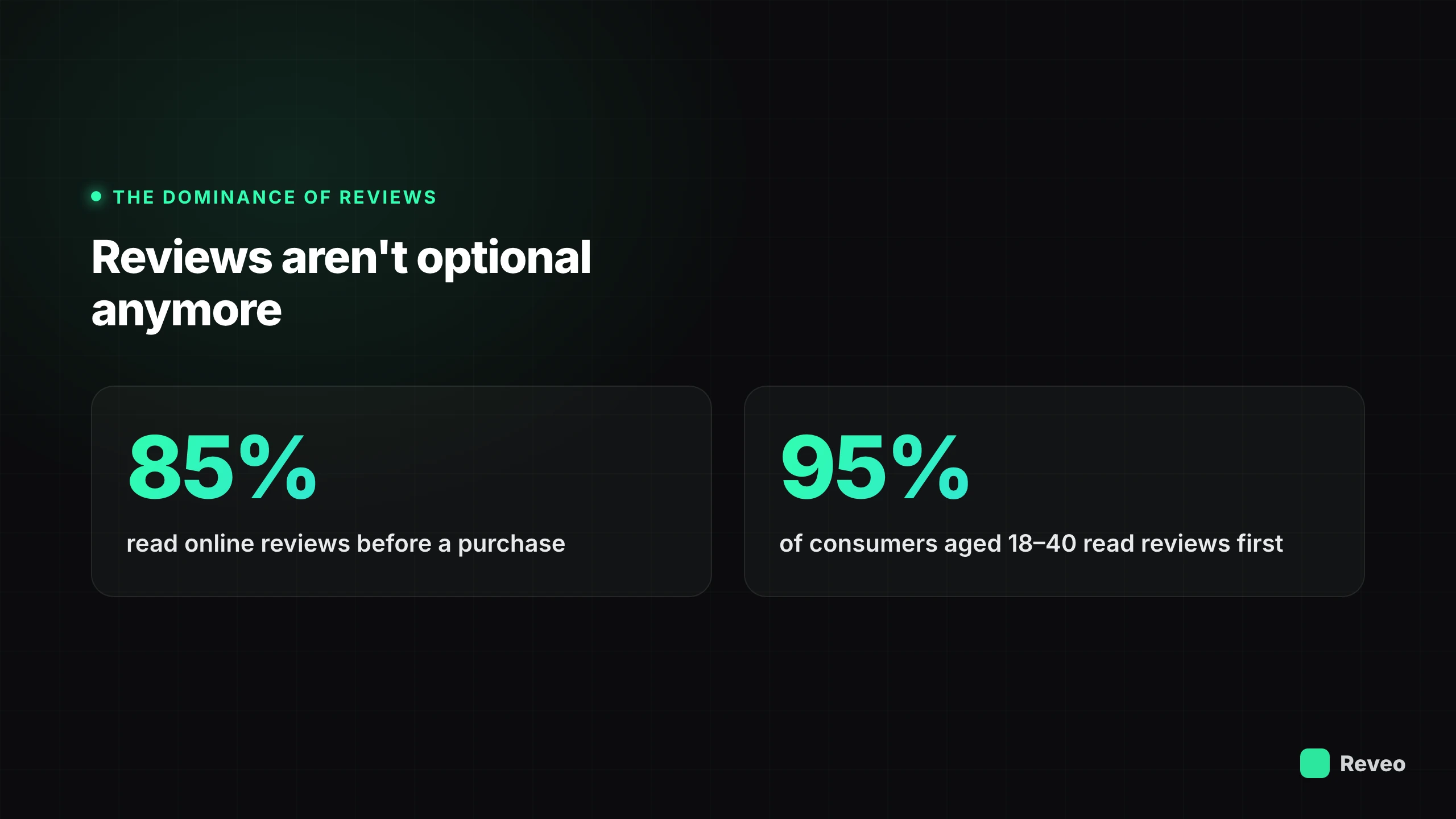
Online reviews have evolved from a novel internet concept into an integral component of the modern buying process. Consumers crave authenticity and assurance, and reviews fill the information gaps that marketing pitches cannot. They provide unfiltered, peer-to-peer insight into what it’s actually like to do business with a company.
3. Positive Reviews: The Silent Salesman
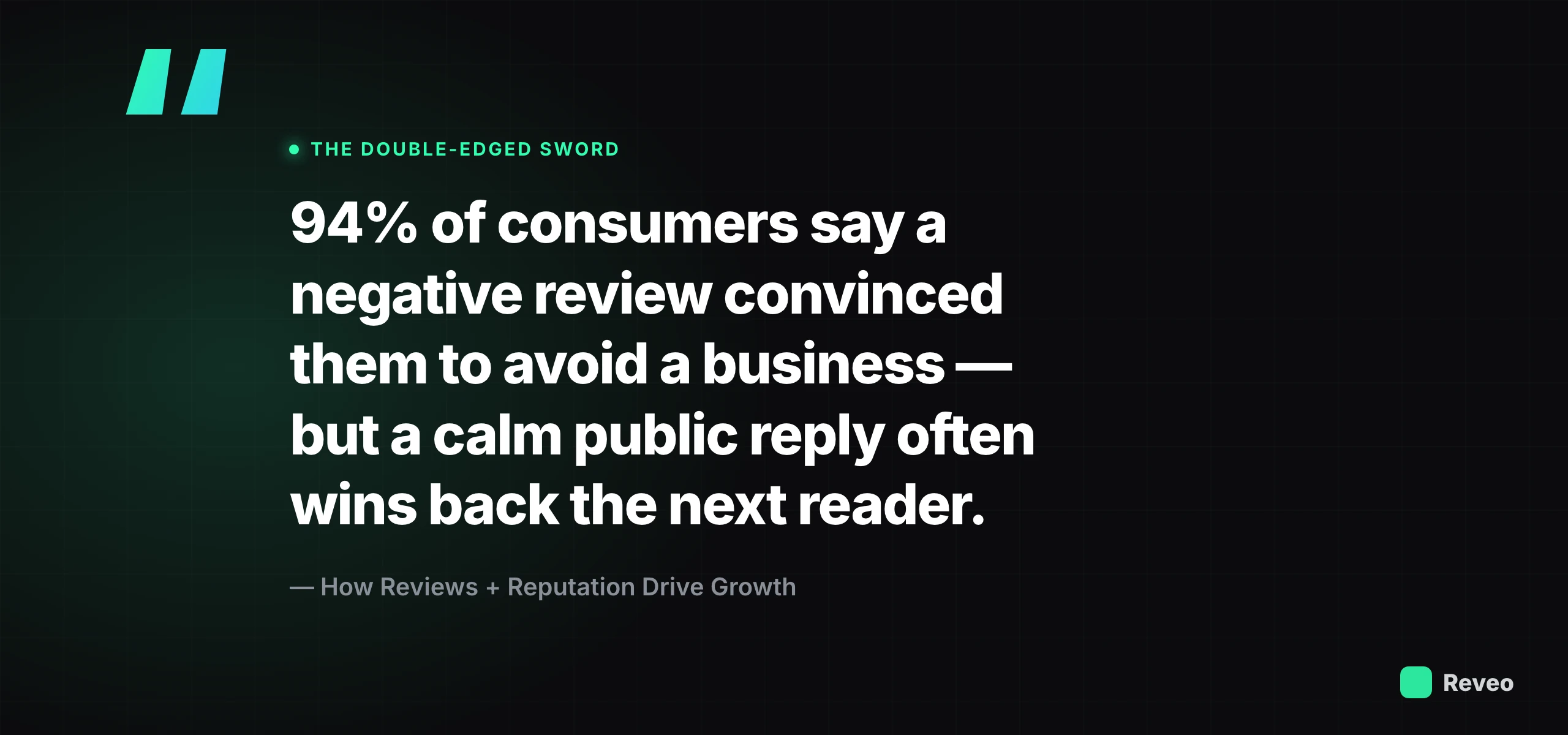
Positive reviews do far more than boost your ego. They function as a silent salesman, working around the clock to convince prospective customers that your business delivers on its promises.
Key Insights
-
Social Proof — Others tried it and loved it. When prospective customers see that peers have had great experiences, it reduces perceived risk and accelerates the decision to buy.
-
Market Differentiation — In a saturated market, reviews set you apart. When features and pricing are similar, the business with better reviews wins every time.
-
Brand Narrative — Reviews cultivate a narrative around your brand — stories of exceptional service, quality products, and genuine care that no ad campaign can replicate.
-
Enhanced Credibility — In a world of skepticism toward advertising, authentic customer voices carry far more weight than any brand-produced message.
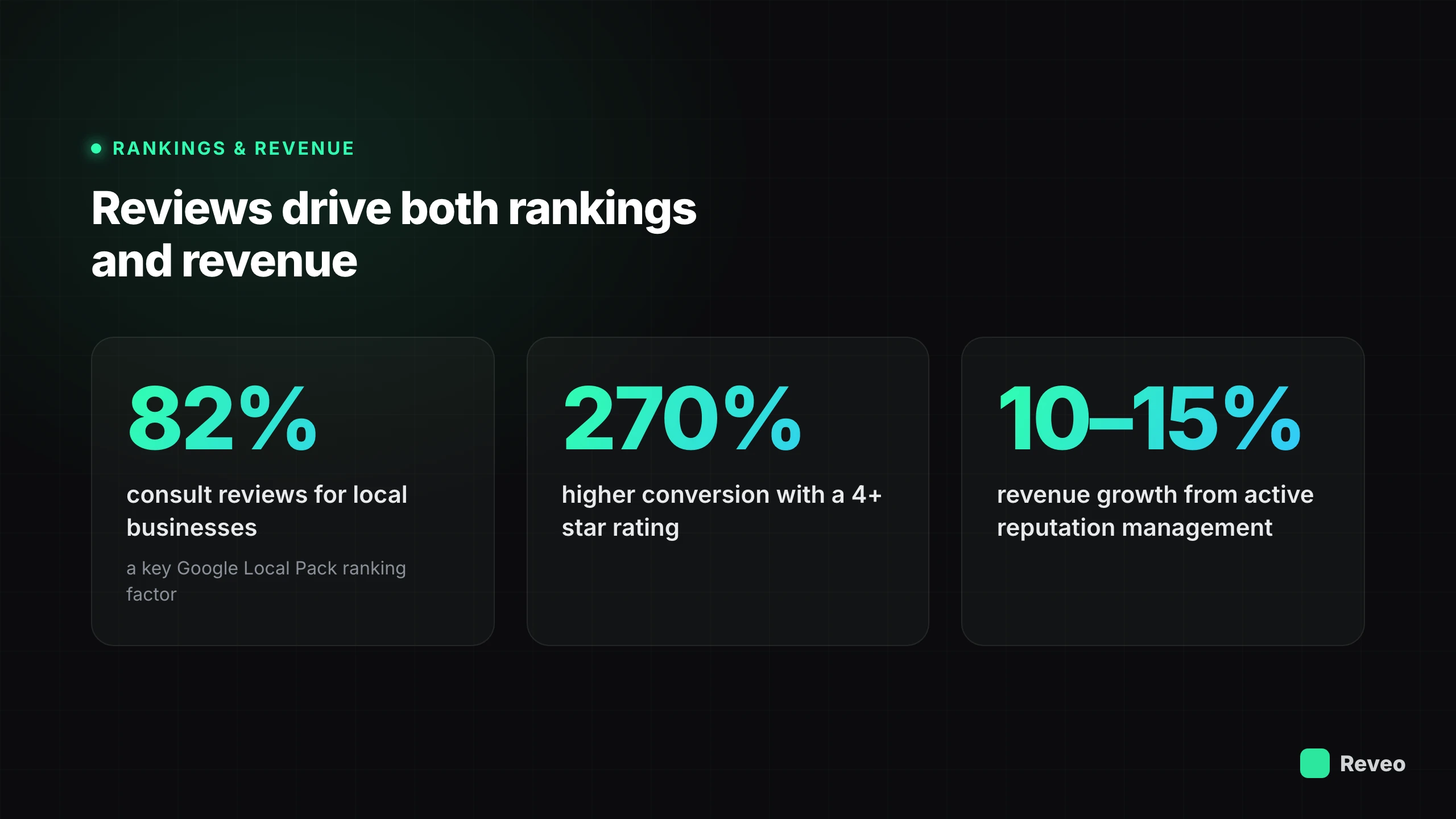
Key stat: Businesses with a 4+ star rating see up to a 270% increase in conversion rates compared to those with lower ratings. Every star counts.
4. Negative Reviews: A Double-Edged Sword
No business is immune to negative feedback. A single harsh review can feel devastating, but with the right strategy, critiques become powerful growth opportunities.
Critical stat: 94% of consumers say a negative review has convinced them to avoid a business. The stakes are high — but so is the opportunity.
Here’s how to reframe negative reviews as an asset:
Spotlight for improvement. Negative reviews surface real operational issues that internal teams might miss. They tell you exactly where your customer experience is falling short.
Response matters more than the review. How you respond to criticism significantly impacts your reputation. A thoughtful, empathetic response to a negative review can actually win more trust than a perfect rating.
Authenticity enhancer. A blend of positive and negative reviews enhances perceived authenticity. Consumers are skeptical of perfect 5-star profiles — a few honest critiques make the positive reviews more believable.
Commitment showcase. Every negative review is an opportunity to learn, grow, and publicly demonstrate your commitment to customer satisfaction.
5. Beyond Damage Control: Proactive Reputation Management
Too many businesses treat reputation management as a reactive exercise — scrambling to respond when a negative review appears. But the most successful companies take a proactive stance, treating reputation as a continuous commitment to excellence.
Strategic Framework
Proactive Stance
Actively seeking feedback rather than waiting for it. Running review campaigns, following up after every service interaction, and making it easy for customers to share their experience.
Reactive Stance
Only engaging when a negative review appears. This leaves your narrative in the hands of your most dissatisfied customers and misses opportunities to amplify positive experiences.
Continuous commitment to excellence — Reputation is not a one-time project. It requires ongoing attention, measurement, and improvement.
Open dialogue and transparent communication — The best brands invite feedback, respond openly, and demonstrate that customer voices are heard and valued.
Revenue impact: Companies that prioritize their online image and actively manage their reputation see 10–15% revenue growth compared to those that don’t.
6. The SEO Impact of Reviews
Reviews don’t just influence consumers — they directly impact how search engines rank your business. Google’s algorithm treats reviews as a significant local ranking factor, and a strong review profile can dramatically improve your visibility in search results.
-
Fresh Content Signals — User-generated content from reviews provides a continuous stream of fresh, relevant content. Search engines reward sites and profiles that are regularly updated with new content.
-
Local SEO Boost — 82% of consumers consult reviews for local businesses. Reviews are a key factor in Google’s “Local Pack” ranking, directly influencing whether you appear in the coveted top-3 map results.
-
Organic Keyword Enrichment — Review language naturally matches the search queries real consumers use. When customers describe your services in their own words, it creates organic keyword signals that improve discoverability.
-
Trust Signals & Rich Snippets — Star ratings displayed in search results (rich snippets) dramatically increase click-through rates. They serve as trust signals for both search engines and consumers scanning results.
-
Engagement Metrics — Active review response improves time-on-site and engagement signals that search engines factor into rankings. A business that responds to reviews looks more credible and active.
7. Building a Review Strategy
A strong review strategy isn’t about gaming the system. It’s about creating a systematic approach to earning, managing, and leveraging customer feedback at every stage of the customer lifecycle.
Encouraging Positive Reviews
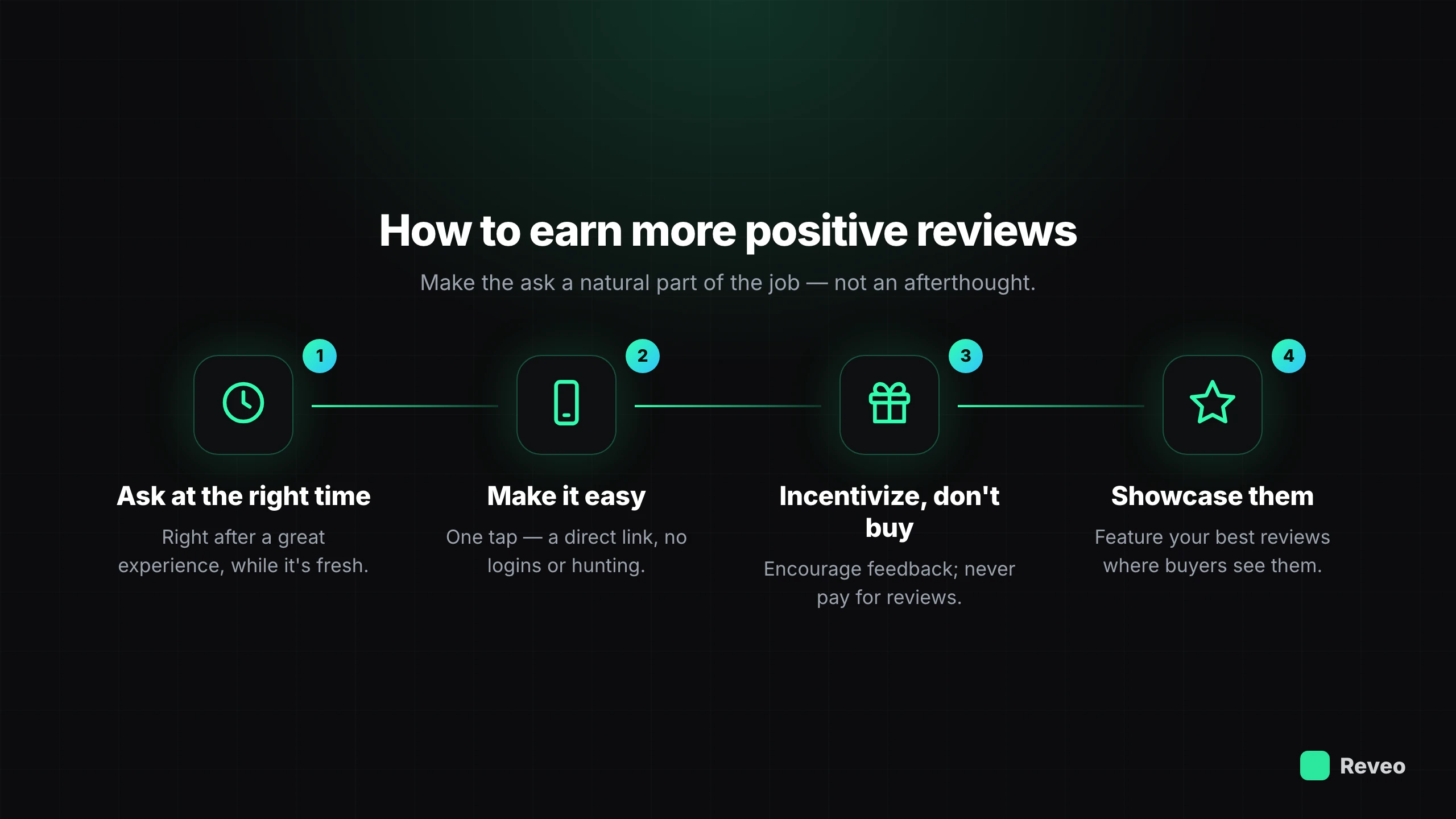
- Request at the Right Time
Ask for reviews when satisfaction is highest — right after a successful service, a completed purchase, or a positive interaction. Timing is everything.
- Make It Easy
Remove friction from the review process. Direct links, SMS prompts, QR codes, and one-click review requests all dramatically increase completion rates.
- Incentivize, Don’t Buy
Encourage reviews through great service and thoughtful follow-up — never through paid incentives or fake reviews. Authenticity is non-negotiable.
- Showcase Positive Reviews
Feature your best reviews on your website, social media, and marketing materials. This creates a positive feedback loop that encourages more reviews.
Addressing Negative Feedback
- Respond Promptly
Speed matters. A quick response shows you’re paying attention and that you care about customer experience. Aim to respond within 24 hours.
- Stay Professional
Never get defensive or argumentative. Acknowledge the customer’s experience, express empathy, and focus on resolution rather than blame.
- Seek Resolution Privately
Acknowledge publicly, then take the conversation offline. Provide a direct contact method to resolve the issue without airing details in public.
- Learn and Improve
Track patterns in negative feedback. If multiple customers mention the same issue, it’s a systemic problem that needs operational attention.
Platform Selection
Not all review platforms carry equal weight for every business. Choosing the right platforms requires understanding where your audience actually looks for information.
Know your audience. Research which platforms your ideal customers use most frequently to find businesses like yours.
Monitor multiple platforms. Even if Google is your primary focus, keep tabs on Yelp, Facebook, industry-specific sites, and any emerging platforms.
Integrate into your workflow. Make review requests a natural part of your post-service or post-sale process rather than an afterthought.
Follow platform policies. Each platform has rules about soliciting reviews. Stay compliant to avoid penalties or review removal.
8. The Role of Reputation Management Software
Managing reviews manually across multiple platforms is unsustainable as a business scales. Reputation management tools like Reveo provide the infrastructure to centralize, automate, and optimize your entire review strategy.
-
Centralization — A unified dashboard aggregates reviews from Google, Facebook, Yelp, and 100+ other platforms into a single view. Real-time alerts ensure no review goes unnoticed, and team members can be assigned to respond without switching between platforms.
-
Streamlined Responses — Response templates, AI-powered suggestions, and direct interaction capabilities enable teams to respond faster and more consistently. Collaboration features let managers review responses before they go live.
-
Analytics & Insights — Sentiment analysis, trend identification, and performance metrics transform raw review data into actionable intelligence. Track your reputation over time, benchmark against competitors, and identify emerging issues before they escalate.
-
Proactive Solicitation — Automated review campaigns triggered by CRM events, service completions, or custom schedules ensure you’re consistently generating new reviews. Integration with existing systems means review requests happen automatically.
-
Continuous Learning — Feedback-driven improvement loops help businesses identify training opportunities, refine processes, and continuously improve customer experience based on real customer voices rather than assumptions.
9. Future Trends
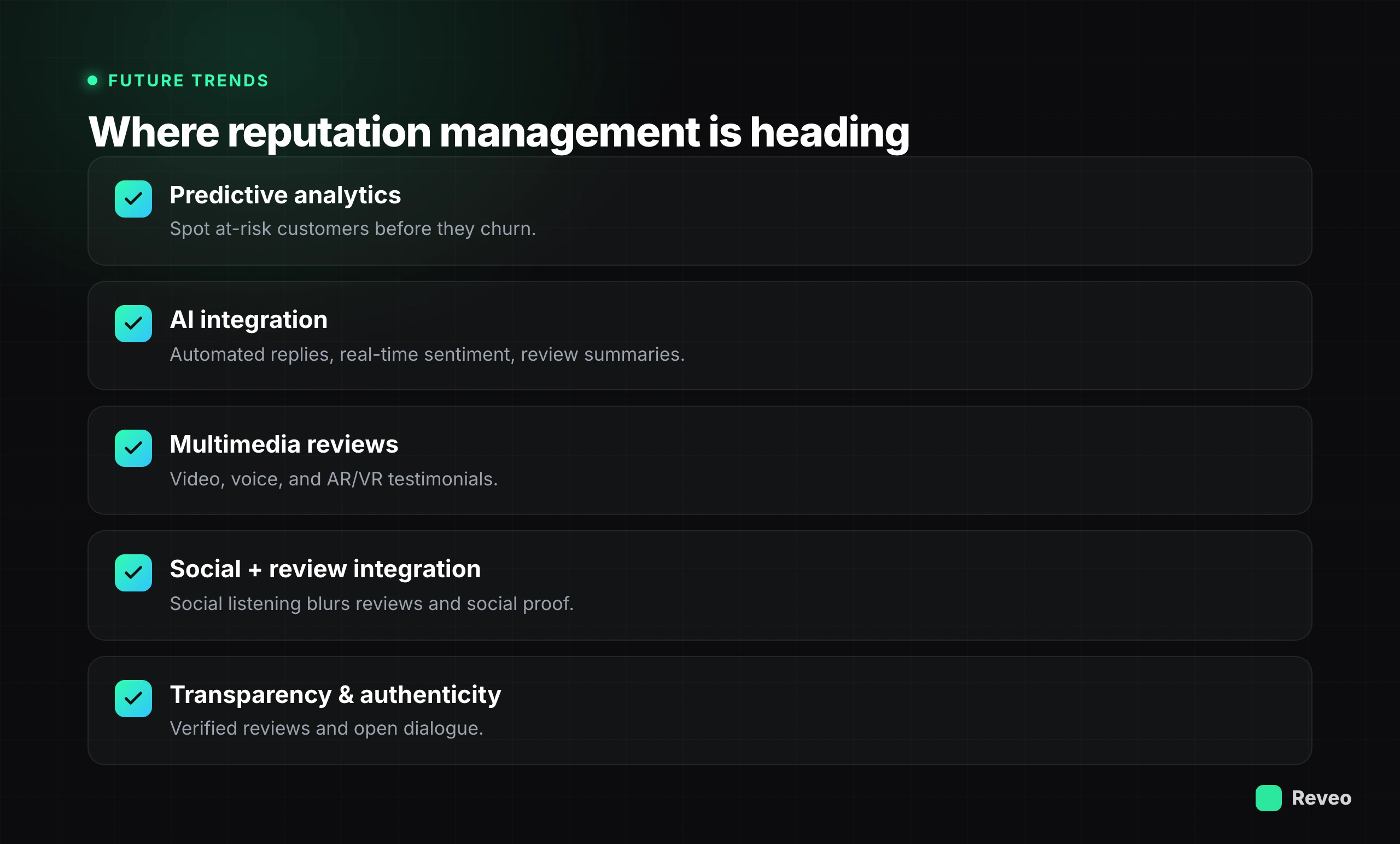
The reputation management landscape is evolving rapidly. Businesses that stay ahead of these trends will have a significant competitive advantage in the years ahead.
Predictive Analytics
Anticipating customer feedback before it happens. Predictive models will identify at-risk customers and enable tailored engagement strategies to prevent negative experiences before they occur.
AI Integration
Automated responses powered by NLP, real-time sentiment analysis, and intelligent review summarization will make reputation management faster, smarter, and more scalable than ever.
Multimedia Reviews
Video reviews, voice testimonials, and even VR/AR demonstrations will add richness and authenticity to the review landscape, creating more engaging and trustworthy customer feedback.
Social Media Integration
Social listening tools, influencer collaborations, and tighter integration between review platforms and social channels will blur the lines between reviews and social proof.
Transparency & Authenticity
Blockchain-verified reviews, open dialogue initiatives, and increasing consumer demand for transparency will push businesses toward more genuine and verifiable reputation practices.
10. Conclusion
In today’s digital marketplace, customer voices hold immense sway. Reviews and reputation management are no longer about damage control — they are about actively weaving a narrative of authenticity, trust, and credibility that drives measurable business growth.
The tools are evolving. From predictive analytics to AI-powered response systems, from multimedia reviews to blockchain-verified authenticity, the future of reputation management is rich with opportunity. But the core principle remains unchanged: the voice of the customer is paramount.
Businesses that embrace reviews as a strategic asset — actively soliciting feedback, responding with care, leveraging insights for improvement, and investing in the right tools — will find that reputation management is not just a defensive tactic. It is a cornerstone for sustained, compounding growth.
Turn Reviews Into Growth
Start managing your reputation and driving revenue.