


Online reputation management (ORM) is the practice of shaping what a potential customer finds when they look up your business — your reviews, your star rating, your business listings, and your search results. For a home-service company, it mostly comes down to one question: when a homeowner Googles “plumber near me” or types your name into their phone, do they see a business they trust enough to call?
That check happens before you ever hear the phone ring. A homeowner reads a few reviews, glances at the rating, maybe skims a competitor two spots down, and decides in about thirty seconds. ORM is the work of winning that thirty seconds on purpose instead of leaving it to whatever happens to be online.
What ORM actually covers
People hear “reputation management” and think “get more Google reviews.” Reviews are the biggest piece, but ORM is wider than that. It’s everything a buyer runs into while sizing you up:
- Reviews and ratings — Google first, then Facebook, Yelp, the BBB, and any platform specific to your trade. Quantity, recency, and how you reply all count.
- Search results — what shows up on page one for your business name: your knowledge panel, your reviews, and any third-party mention (news, forums, a complaint thread).
- Business listings — your name, address, phone, and hours across the directories that feed Google. When those disagree, Google trusts you less and so do customers.
- Social and community — Facebook, Instagram, and Nextdoor, where a neighbor asking for a recommendation is often your next lead.
Two kinds of work run across all of that. Proactive ORM builds the good stuff — asking every customer for a review, keeping listings clean, putting your best feedback where buyers see it. Reactive ORM handles the incoming — replying to a bad review, correcting wrong information, catching a problem the same day instead of the next month. A real reputation program does both; skip the proactive half and you spend all your time putting out fires.
ORM vs. review management
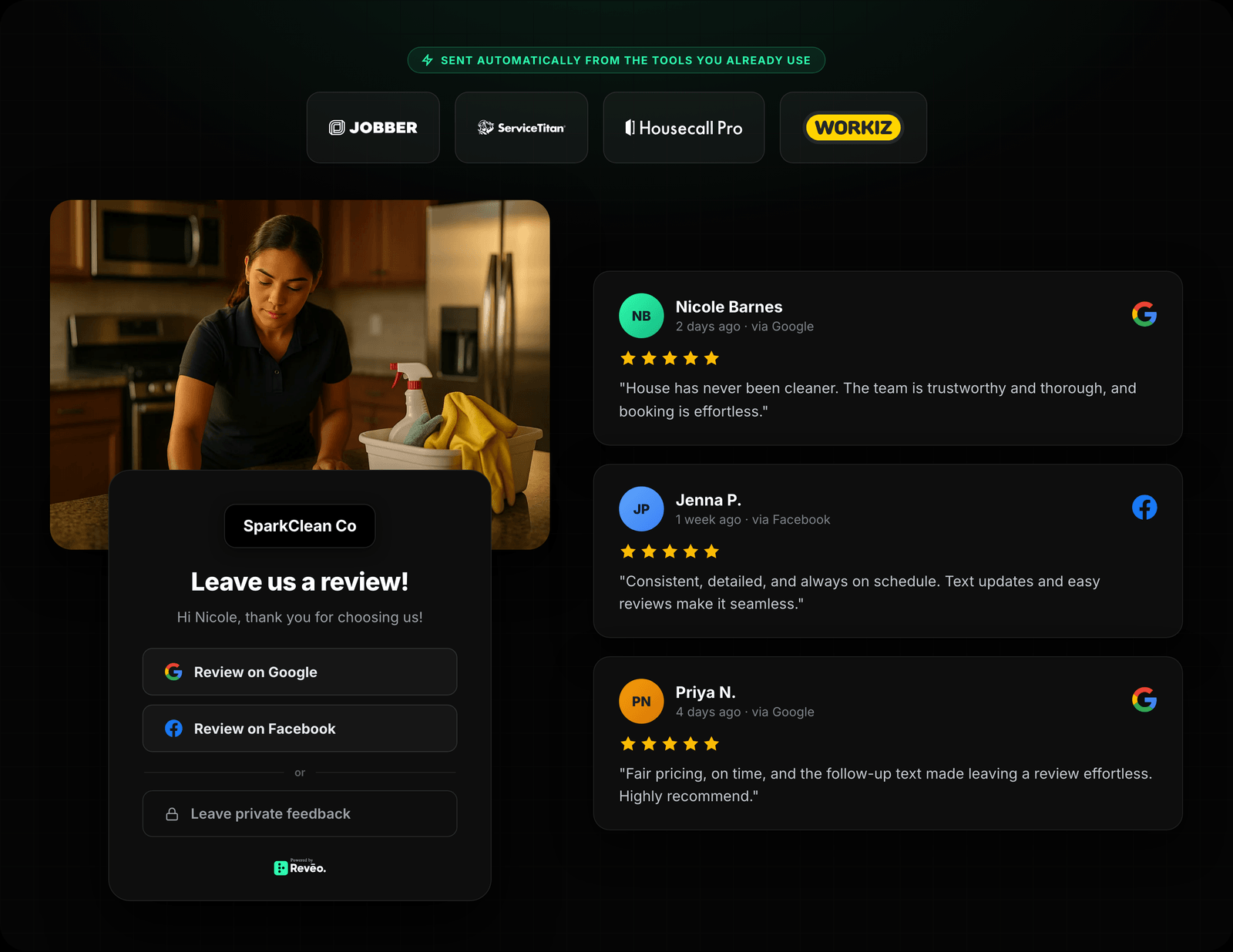
These two terms get used interchangeably, and they shouldn’t be. Review management is one part of ORM — the part focused on generating, monitoring, and responding to reviews. ORM is the whole discipline that wraps around it and adds listings, search results, and social presence.
Here’s the simple version: review management is the engine, ORM is the whole vehicle. You can’t get anywhere without the engine — reviews are what move your ranking and win the click — but the engine alone isn’t the car. If your reviews are strong and your listings are wrong or a bad search result sits on page one, buyers still walk. If you want to go deep on just the review side, our review management guide covers the generation and response mechanics in detail.
Who needs ORM

If customers can find you online, you need it — and small home-service operators need it most. A national chain can absorb a rough month; a two-truck HVAC company competing on the same search page can’t. The upside is that small businesses are also the ones best positioned to win at it. You have a direct relationship with every customer, so asking for a review feels natural, not corporate. One owner running a consistent system can build a reputation that outperforms competitors ten times their size.
The proof shows up fast when a company commits to it. EcoStar Pest Control built 1,015 Google reviews from a single location — the kind of density you’d expect from a regional chain, not a local shop. Owner Pete Updike’s read is blunt: most pest companies in his area sit between 50 and 200 reviews, so customers click his listing first. That gap isn’t luck or budget. It’s a system that asks every customer, every job.
How to actually do it

Knowing what ORM is doesn’t get you reviews — a repeatable process does. The short version: ask every customer for a review right after the job by text, reply to everything you get, keep your listings accurate, and put your best reviews where buyers see them. Do that consistently and your rating, review count, and local ranking all start moving together.
The longer version — the timing that makes a review request convert, how to respond to a one-star review, how to wire the request to fire automatically off your field software — is its own playbook. We wrote it up in the complete home-service ORM guide, which is the step-by-step how-to underneath this primer.
Where to start
Before you build anything, find out where you actually stand. Google your business name, check your rating and review count on Google, Yelp, and Facebook, and note anything wrong — outdated hours, unanswered reviews, or a bad result on page one. That’s your baseline, and it usually surprises people.
Want the baseline without doing it by hand? Run a free reputation scan — it checks your reviews, rating, and listings in a couple of minutes, so you know exactly what a customer sees before you decide what to fix first.