


Google reviews matter because they decide who a homeowner calls before you ever get the chance to sell — your rating and review count are the first filter, and the company with 400 recent reviews gets the click while the one with 30 gets scrolled past. Understanding the importance of Google reviews comes down to four concrete mechanics, not sentiment: they move your local ranking, they convert lookers into calls, they show up on the balance sheet when you sell, and their absence quietly hands jobs to the competitor one spot above you.
This isn’t theory. We run reviews and reputation for hundreds of home-service locations, and the gap between the companies that treat Google reviews as a system and the ones that don’t is measured in calls per week. Here’s what actually drives that gap.
Reason 1: They move your local ranking
When a homeowner searches “pest control near me” or “emergency plumber,” Google decides which three businesses land in the map pack at the top. Review volume, recency, and star rating are part of how it makes that call — a profile collecting fresh reviews every week reads to Google as an active, trusted business, and it ranks accordingly.
The density is the point. EcoStar Pest Control built 1,015 Google reviews from a single location. Most pest companies in their area sit between 50 and 200. That gap is why, in owner Pete Updike’s words, customers click EcoStar first — the social-proof difference is enormous, and it shows up in ranking before a single ad dollar is spent.
Reviews and local SEO are really the same project. The reviews that convince a reader also feed the ranking that puts you in front of the next one. Skip the asking and you’re not just quiet — you’re invisible in the exact search where the job is decided.
Reason 2: They turn clicks into calls
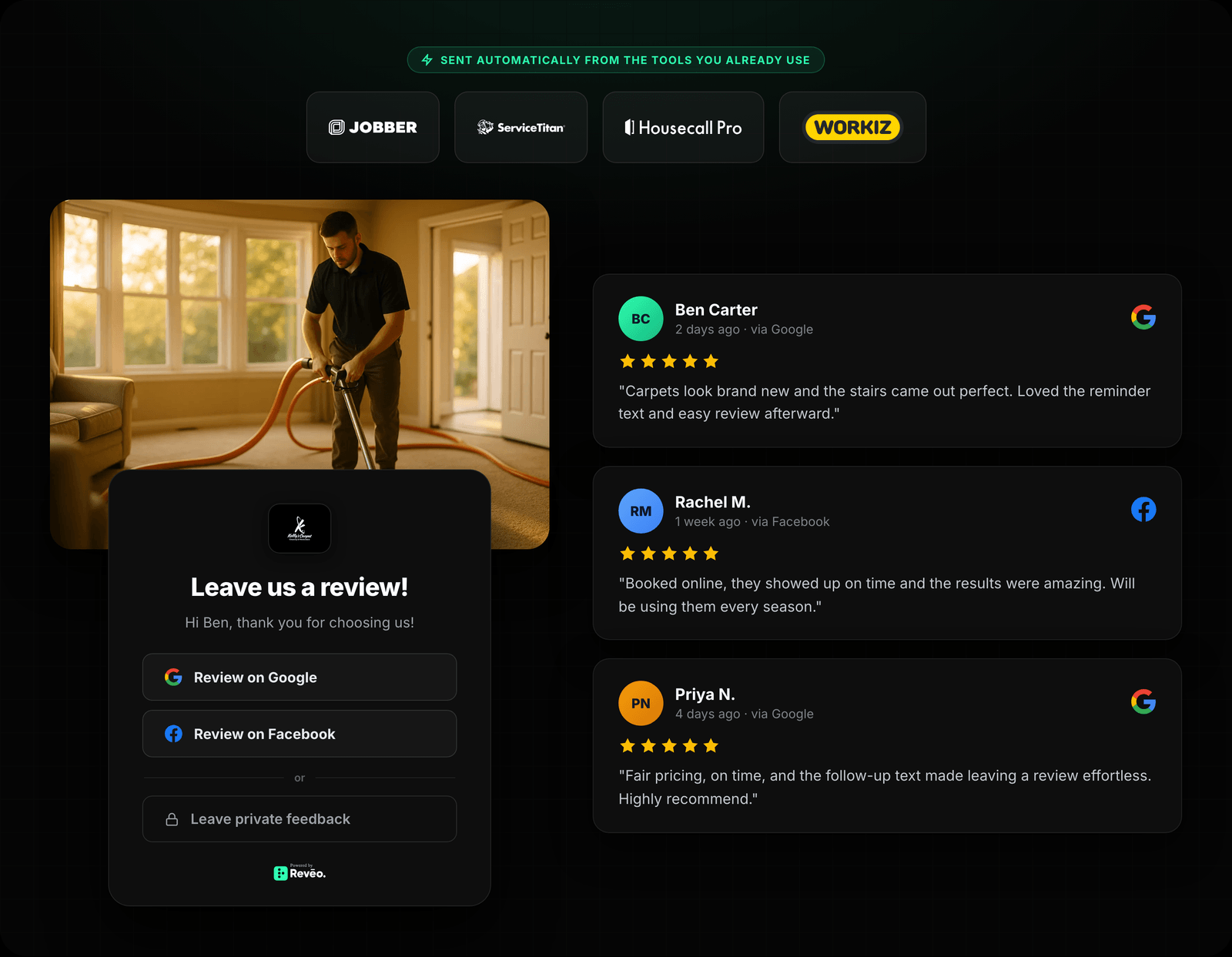
Ranking gets you seen. Reviews get you chosen. Put two pest-control results side by side — one at 4.8 stars from 300 reviews, the other at 3.9 from 18 — and the homeowner picks the first without thinking about it. That’s not vanity; that’s conversion, and it happens thousands of times a day in local search.
Two things do the converting: the rating (the number they glance at first) and the recency (a wall of reviews from this month says the business is busy, current, and safe to trust). A high rating from reviews that stopped two years ago reads as a company that either got complacent or stopped caring. Recency is the tell.
This is also why responding matters more than most owners think. Future customers read your replies more than the reviews themselves — a measured, specific answer to a one-star complaint often wins the next lead better than a flawless average would. The playbook for responding to negative reviews covers the exact structure: acknowledge, take it offline, never argue in public. If you want the mechanics of turning review volume into booked jobs, we broke that down in how reviews drive conversions.
Reason 3: They become a balance-sheet asset

Here’s the reason owners underrate until they go to sell. A dense, active review profile isn’t just marketing — it’s an asset a buyer pays for.
Romney Pest Control built 2,337 reviews, and when Greg Romney sold the company, that review density directly influenced the valuation. A buyer isn’t only purchasing trucks and a customer list; they’re buying a top-of-search position and a public reputation that keeps producing leads on day one. Reviews are the proof that the lead flow is real and defensible, and that proof carries a dollar figure.
You can’t buy that number or fake it — Google’s policies and your own honesty forbid it — which is exactly why it’s worth something. It’s the accumulated result of asking every customer, every job, for years. BRD Pest Control tripled its review velocity — 3.4× in its first 17 days after making the ask automatic, and Scoop Soldiers, a 47-location pet-waste franchise, ran their velocity up roughly 10× the same way. Velocity compounds: this year’s asking is next year’s asset.
Reason 4: The cost of not having them is real
Every job you don’t ask about is a review a competitor collects instead. The damage from being under-reviewed is quiet — no alert fires, nothing breaks — which is exactly why it goes unfixed for years while the business one listing above you pulls ahead.
Under-reviewed businesses also take the full weight of every bad review. A company collecting reviews every week barely feels a one-star day; a company sitting at 30 reviews total feels every single one, because there’s no volume to dilute it. The most reliable defense against a bad review isn’t a clever reply — it’s enough recent positives that one miss barely moves the average.
The reason most home-service companies have 40 reviews instead of 400 is not effort. It’s memory. The tech finishes the job, gets in the truck, and the ask never happens. Take the person out of the loop — fire the request automatically when a job is marked complete in your field software, by text, while the customer is still standing in the clean kitchen — and the whole problem disappears. That timing is most of the battle: a request sent within the hour converts far better than one sent the next day. The full sequence lives in our guide to asking for reviews the right way.
What to do about it this week
The importance of Google reviews isn’t in doubt — the only variable is whether you build them on purpose or leave them to whoever remembers. Three moves start the compounding:
- Turn on automatic review requests for every completed job, sent by text within the hour.
- Reply to every review you haven’t answered — start with the negatives.
- Fix your Google Business Profile so your hours, phone, and services are correct — it’s the profile customers actually see.
Do those consistently and your rating, review count, and local ranking all start moving in the same direction — the same compounding that turned EcoStar’s and Romney’s review counts into a real competitive edge.
Want to see where you stand today? Run a free reputation scan for a snapshot of your reviews, rating, and listings in a couple of minutes.