


Every statistic below comes from a named, checkable source — BrightLocal, Northwestern’s Spiegel Research Center, a Harvard Business School study, Womply, and Moz — because a review statistic you can’t trace is worse than no number at all. Here are 21 online review statistics that hold up, what each one actually measured, and what it means for a business trying to win the customer who’s reading reviews right now.
If you want the short, curated version instead of the full roundup, we keep a running highlight set on the review statistics page. This post is the comprehensive list — every data point, grouped by what it tells you.
Do people actually read reviews?
1. 97% of consumers read reviews for local businesses. (BrightLocal Local Consumer Review Survey, 2026.) Reading reviews is now close to universal — the exception is the person who doesn’t, not the one who does.
2. 41% “always” read reviews when browsing for a business — up from 29% a year earlier. (BrightLocal, 2026.) The habit isn’t just widespread, it’s intensifying.
3. 49% trust online reviews as much as a personal recommendation. (BrightLocal, 2026.) Roughly half of your prospects weigh a stranger’s review the same as advice from a friend. That’s the whole reason a review profile is worth managing.
The bar buyers set before they’ll consider you
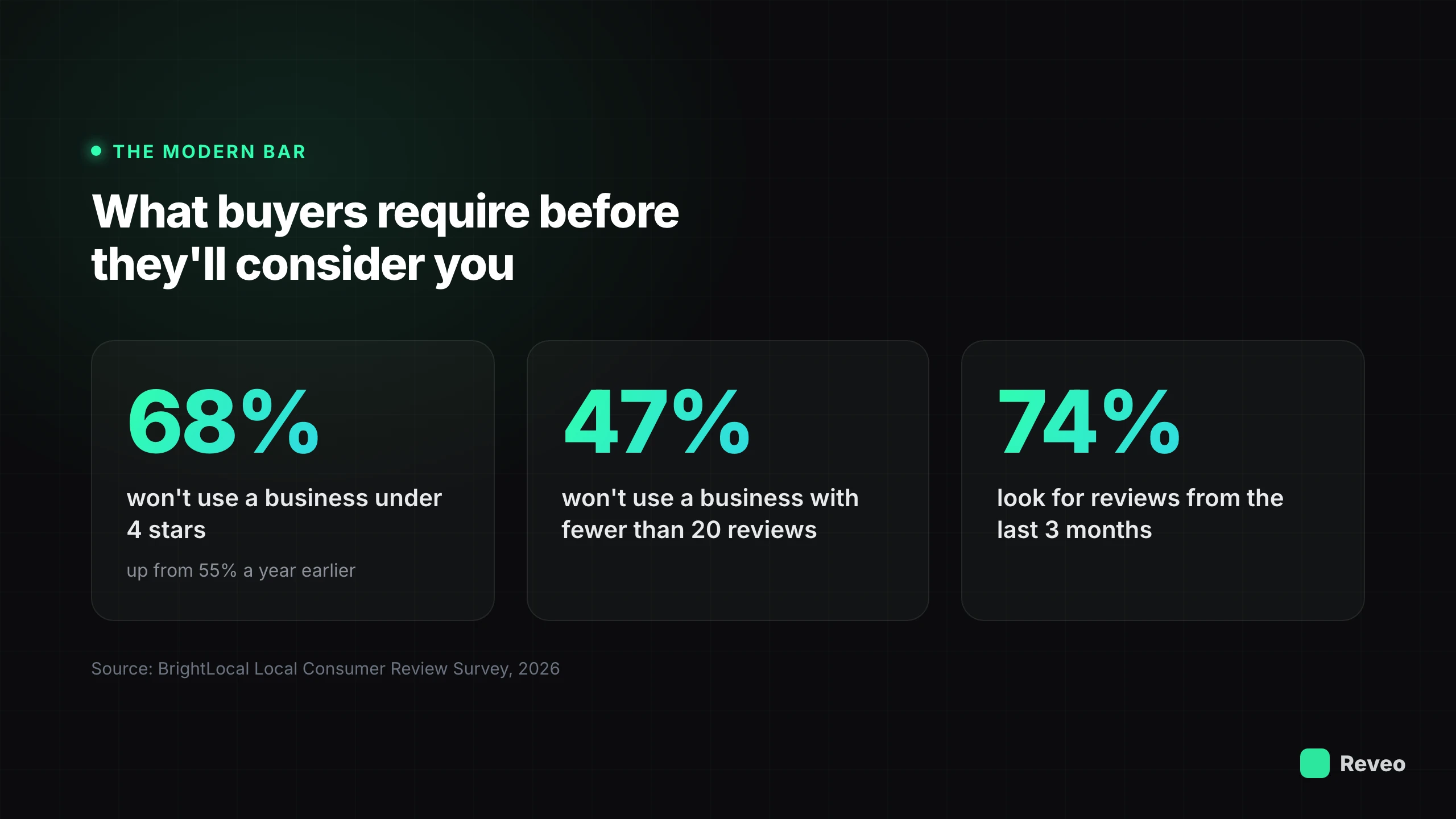
4. 68% will only use a business rated four stars or higher — up from 55% in 2025. (BrightLocal, 2026.) A 3.8 average quietly removes you from most people’s shortlist.
5. 31% will only use a business rated 4.5 stars or higher. (BrightLocal, 2026.) Nearly a third have pushed the bar even higher, which makes the gap between 4.2 and 4.6 stars matter more than it used to.
6. Just 3% would consider a business averaging two stars or fewer. (BrightLocal, 2024.) A low rating isn’t a discount — for almost everyone, it’s a hard stop.
7. 47% won’t use a business with fewer than 20 reviews. (BrightLocal, 2026.) A great rating on four reviews reads as “not enough to trust yet.” Volume is its own signal.
8. 74% look for reviews written in the last three months. (BrightLocal, 2026.) Reviews go stale. A wall of five-stars from two years ago doesn’t reassure the way three from last week does.
9. 32% specifically look for reviews from the last two weeks — up from 20% in 2025. (BrightLocal, 2026.) Recency expectations are tightening fast, which rewards a steady flow over an old pile.
Responding is now part of the decision
10. 80% are more likely to use a business that responds to all its reviews. (BrightLocal, 2026.) Replying isn’t customer service anymore — it’s a conversion lever the next reader watches.
11. 19% expect a same-day response to their review — up from 6% in 2025. (BrightLocal, 2026.) The window customers give you is collapsing. Same-day is becoming the default expectation, not the exception.
12. 50% are unlikely to choose a business that uses generic, templated replies. (BrightLocal, 2026.) A copy-paste “Thanks for your feedback!” on every review now works against you. Specific beats fast-and-canned. (Here’s our playbook for responding to negative reviews the way that actually helps.)
Where people go to read reviews
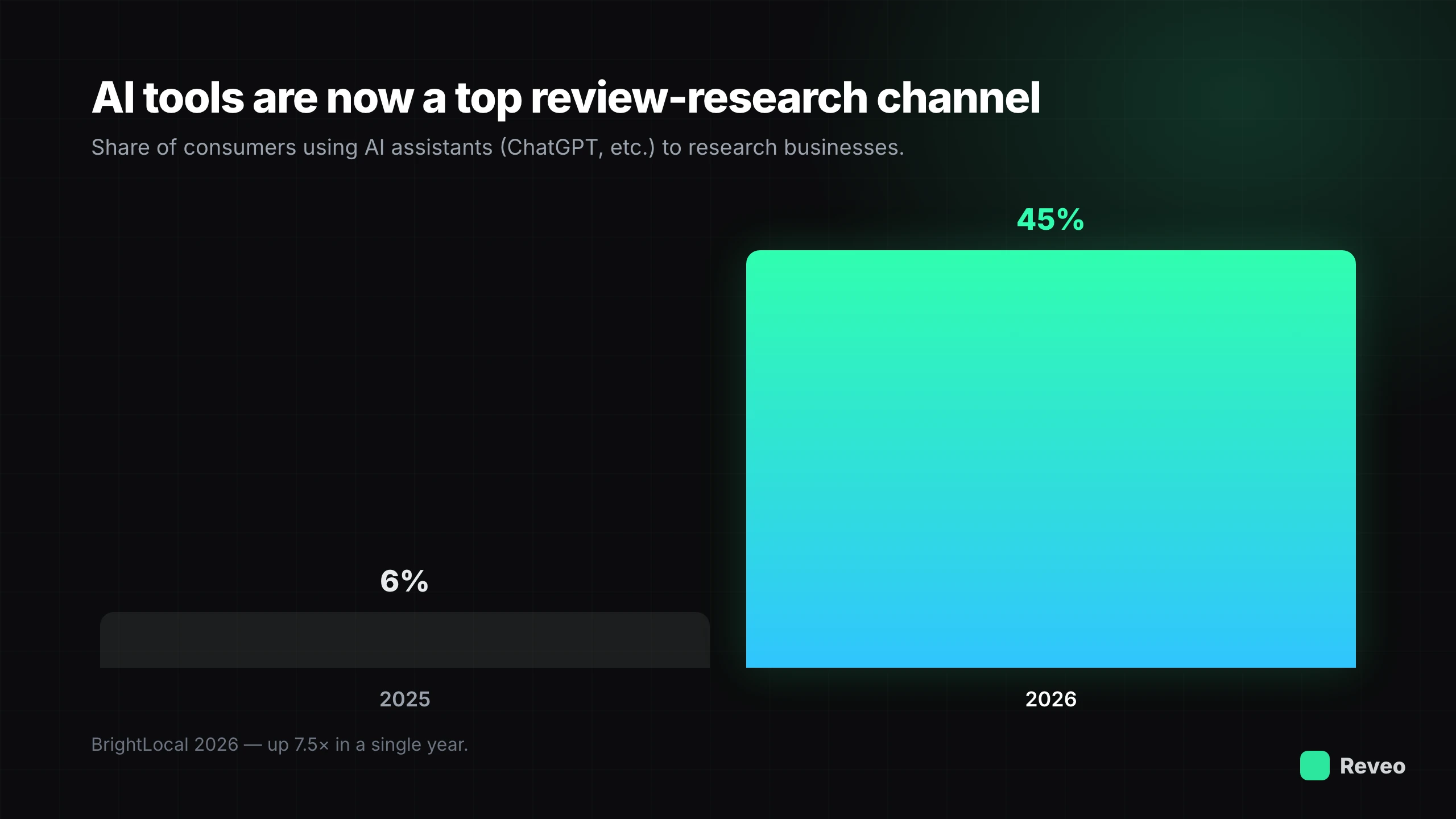
13. Google is the most-used review platform at 71%, and AI tools like ChatGPT have jumped to 45% — up from 6% a year earlier. (BrightLocal, 2026.) Google still leads, but the surface is fragmenting. AI assistants that summarize your reviews are now a top-three research channel, and they read the same review corpus your customers do.
Reviews and revenue — the part owners care about
This is where the studies stop describing behavior and start measuring dollars.
14. Purchase likelihood is 270% higher for a product with five reviews than one with none. (Spiegel Research Center, Northwestern University.) The first handful of reviews does the heaviest lifting — going from zero to five moves the needle more than any jump after that.
15. Purchase likelihood peaks at ratings between 4.0 and 4.7 stars, then declines toward 5.0. (Spiegel Research Center.) A perfect 5.0 reads as too good to be true. The sweet spot is high but human — a few honest three-star reviews can actually help you convert.
16. Displaying reviews lifted conversion 380% on a higher-priced product vs. 190% on a cheaper one. (Spiegel Research Center.) The more a customer is about to spend, the more the reviews decide it — which is exactly the profile of most home-service jobs.
17. A one-star increase in Yelp rating drives a 5–9% increase in revenue for independent restaurants. (Harvard Business School, Michael Luca, “Reviews, Reputation, and Revenue.”) This is one of the few clean, causal measurements of a rating’s dollar value, and the effect was concentrated in independents — not chains.
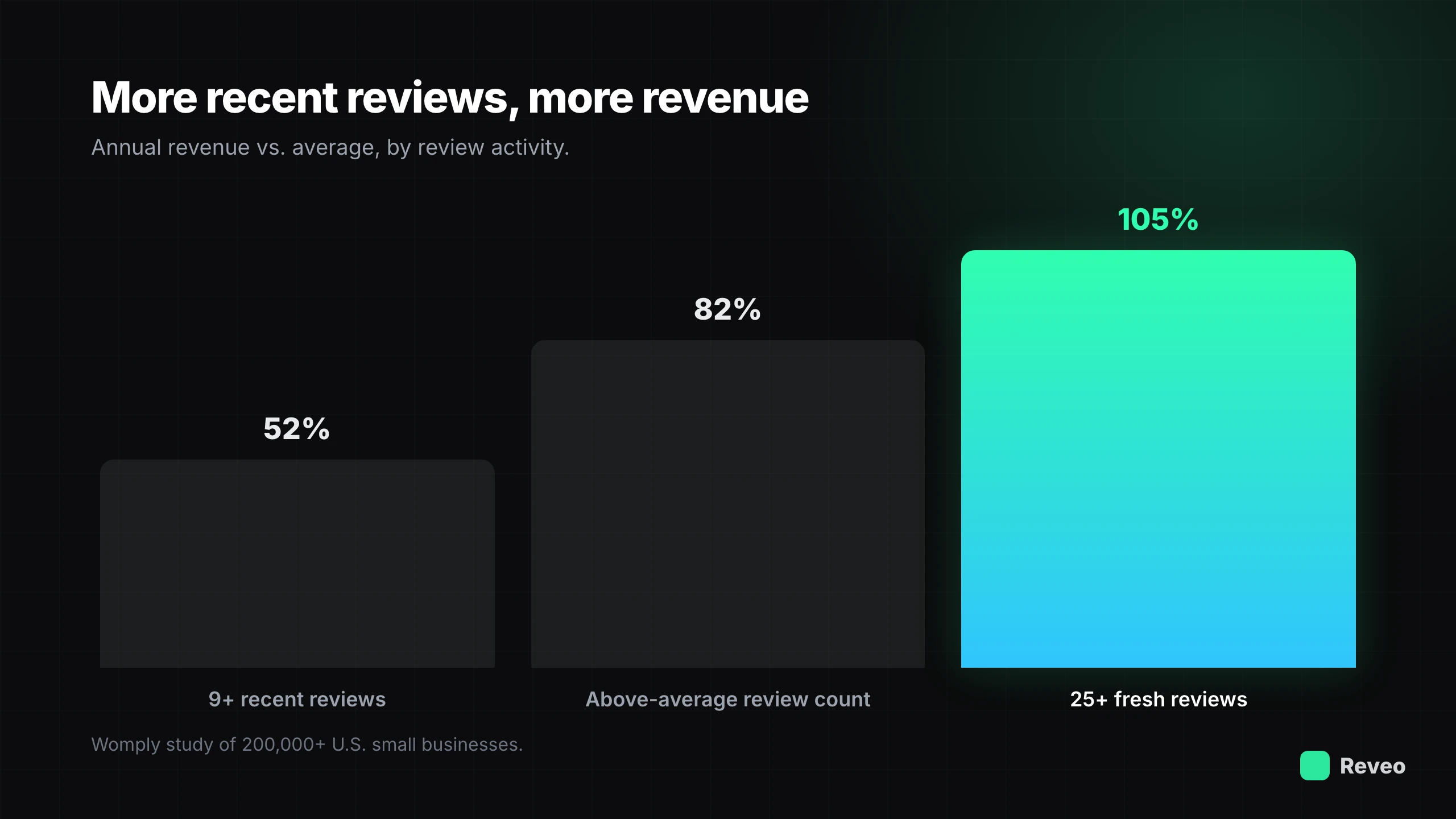
18. Businesses with more than nine recent reviews (within 90 days) earn up to 52% more than average. (Womply study of 200,000+ U.S. small businesses.) “Recent” is doing the work here — the revenue lift tracked fresh reviews, not lifetime totals.
19. Businesses with 25 or more fresh reviews earn up to 105% more than average. (Womply.) More recent reviews kept correlating with more revenue, well past the point most owners stop asking.
20. Review counts predicted revenue more strongly than star ratings — businesses with an above-average number of reviews brought in 82% more annually. (Womply.) Chasing a perfect average matters less than most owners think; the number of reviews, and how fresh they are, tracked revenue harder than the stars did.
21. Review signals account for roughly 15% of local-pack ranking weight — one of the largest factors in local search. (Moz Local Search Ranking Factors.) Reviews don’t just convince the reader; their quantity, velocity, and recency help decide whether you show up in the Google map results at all. That’s why reviews and local search visibility are really the same project.
What the numbers add up to
Read together, the studies point at one thing: fresh volume beats a frozen perfect rating. Recency thresholds are tightening (stats 8, 9), review count predicts revenue harder than stars (stats 18–20), the first few reviews matter most (stat 14), and a flawless 5.0 can even work against you (stat 15). The business that quietly asks every customer, every job, and replies to what comes back is the one these numbers reward.
We see it in the accounts we run. EcoStar Pest Control built 1,015 Google reviews from a single location — the kind of density that puts them first in the map pack while most competitors sit at 50 to 200. Scoop Soldiers, a 47-location pet-waste franchise, roughly 10בd its review velocity once the ask became automatic instead of “whoever remembers.” Neither came from an ad budget. They came from turning the numbers above into a system.
If you want the full framework behind that, start with the online reputation management playbook. And if you just want to know where you stand today, run a free reputation scan — it pulls your current review count, rating, and listings in about two minutes, so you can see which of these thresholds you’re already clearing and which you’re not.