


If you run a home-service business and want to know which are the best review platforms to spend your time on, here’s the short answer: Google first, and it isn’t close. For a plumber, HVAC company, roofer, or pest-control tech, Google is where buyers search, where your star rating decides who gets the map-pack spots, and where nearly all of your review ROI lives. Everything else — Facebook, Yelp, Angi, BBB, the niche directories — is a secondary layer you add after Google is strong, not a set of equal options to spread yourself thin across.
This is a ranking, not a directory — the full multi-platform strategy playbook covers the reasoning in more depth if you want it. Below is where each platform actually sits for a home-service company in 2026, what it’s worth, and how to prioritize when you have limited hours and a truck to run.
The ranking, plainly
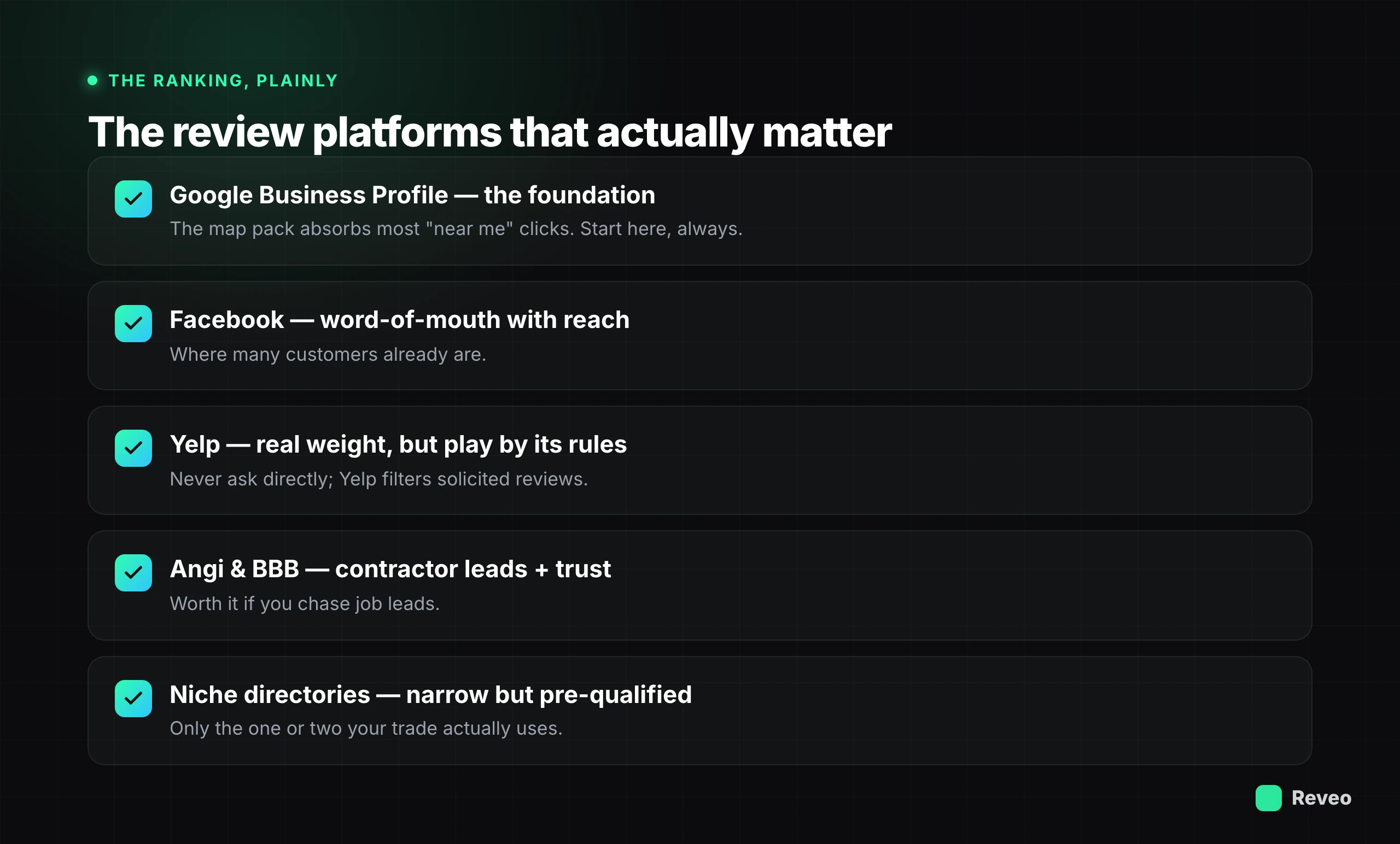
Google is the overwhelming majority of the game. When a homeowner needs a service pro, they don’t open Yelp or a niche directory — they Google “[trade] near me,” and the top three map-pack results absorb most of the clicks. Your Google review count and rating are the biggest lever on whether you land in those three. That’s why the first company that commits to review volume in a market usually pulls away: EcoStar Pest Control built 1,015 Google reviews from a single location, and as owner Pete Updike describes it, most pest companies in his area sit at 50 to 200 — so customers click EcoStar first. That density is a Google story, not a multi-platform one.
Everything after Google is worth having, but the drop-off is steep. Here’s the order that holds for most home-service trades.
1. Google Business Profile — the foundation
Nothing else is close for local service. Your rating and review count directly affect whether you appear in the map pack, and your reviews also surface in Google Maps, local search, and increasingly in AI overviews. Every review you earn here compounds across the whole Google surface.
The bar to compete in most local markets is 50+ reviews at a 4.5+ rating, then keep the velocity up so your reviews stay recent. Recency matters — a wall of reviews from three years ago reads as a business that’s coasting. If you do one thing this quarter, make it a steady stream of fresh Google reviews. Our guide to generating more Google reviews covers the mechanics, and your Google Business Profile itself needs to be fully filled out for any of it to convert.
2. Facebook — word-of-mouth with reach
Facebook recommendations show up in the feed and are visible to the reviewer’s friends, which turns one happy customer into local word-of-mouth. For home-service companies that live on neighborhood referrals, that’s genuinely useful: when a homeowner recommends your plumbing company in a local group, their network sees it.
It’s second, not first, because Facebook recommendations don’t drive high-intent search the way Google does — someone scrolling their feed isn’t actively hunting for a contractor. Treat Facebook as amplification: share your strongest reviews, respond to every recommendation, and let it extend the trust you’re already building on Google. Don’t know where your Facebook review link lives? Here’s how to generate it.
3. Yelp — real weight, but play by its rules
Yelp carries weight with buyers who are actively comparing options, and it matters more in dense metro markets where competition is fierce. The catch is its solicitation policy: Yelp discourages asking for reviews and its filter hides anything it reads as solicited, so the usual “ask every customer” playbook backfires here.
The move on Yelp is indirect. Deliver work worth talking about, make your profile easy to find (here’s how to generate your Yelp review link for that purpose — your site and email signature, not a direct ask), keep photos current, and respond to reviews professionally — especially the negative ones, where future customers judge how you handle it. Don’t route review requests here.
4. Angi and BBB — contractor-lead and trust signals
Angi (and the HomeAdvisor inventory folded into it) is where consumers go specifically to hire a contractor — high intent, ready to book. Your rating and review count there directly affect lead quality and volume, and reviews often carry project detail, cost, and photos that give buyers a concrete picture of the job. Speed to lead is the whole game on Angi: respond fast or the lead goes cold.
BBB is less a lead source than a trust signal. An accredited profile with a clean record reassures the cautious, older homeowner demographic, and the consistent business info reinforces your local citations. Worth claiming and keeping accurate; not worth a heavy review push.
5. Niche directories — narrow but pre-qualified
Trade-specific platforms — Houzz for remodeling and design, Porch for home improvement, Thumbtack for general services — serve smaller audiences that are deep in the decision. Volume is low, but the visitor is already searching for your exact category, so conversion tends to be higher per view. Add these only when they match your trade. A remodeler belongs on Houzz; a pest-control company mostly doesn’t.
How to prioritize when you’re busy
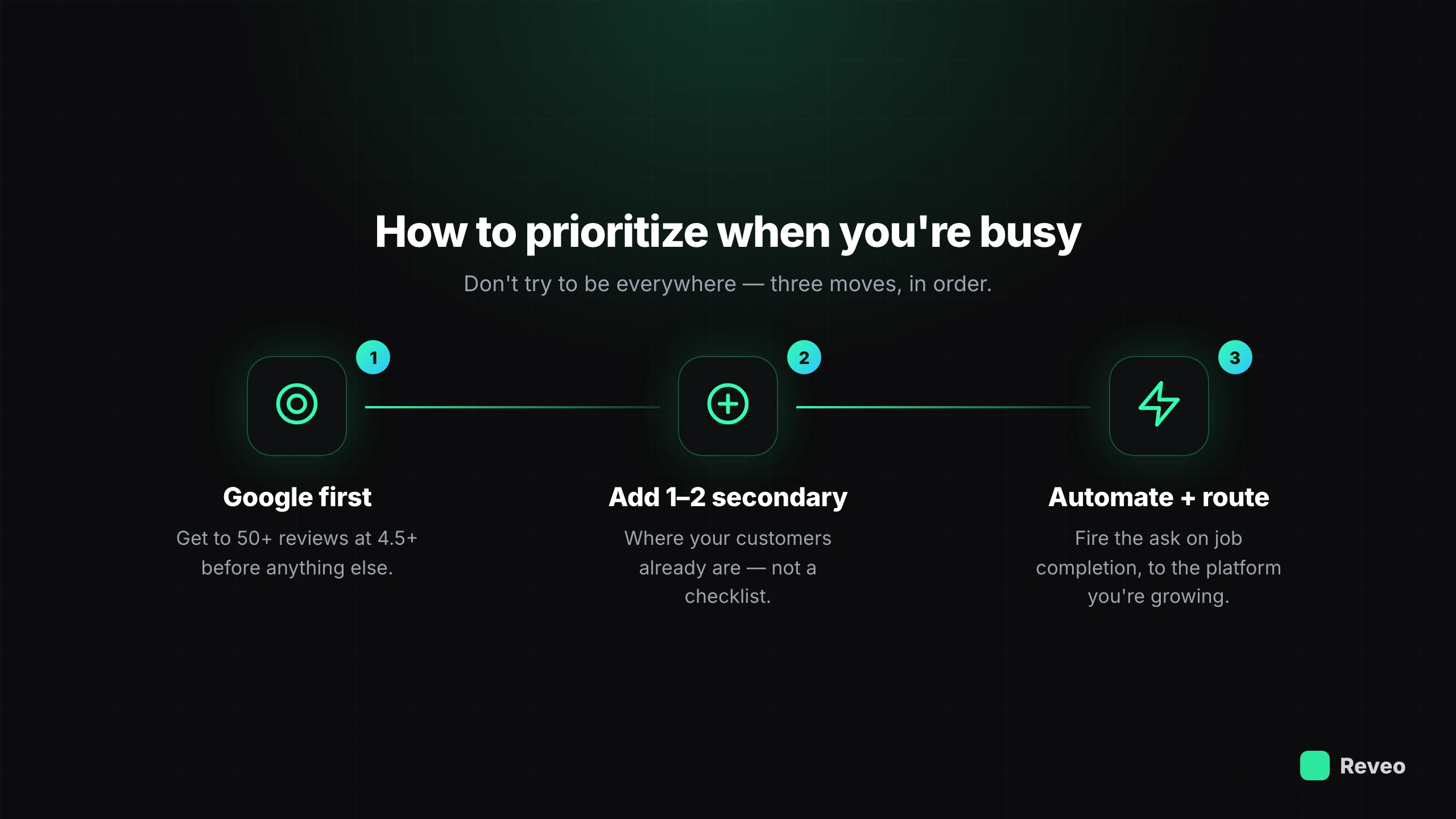
Don’t try to be everywhere. Three moves, in order:
- Get Google to critical mass first. Put essentially all of your review-generation effort into Google Business Profile until you clear 50+ reviews at 4.5+. This is the foundation, and until it’s solid, effort spent elsewhere is effort stolen from the platform that actually pays.
- Add one or two secondary platforms that fit your trade. Facebook for almost everyone; Angi for contractors chasing job leads; Houzz for remodelers. Pick based on where your customers already are, not on filling out a checklist.
- Automate the asking, and route by platform. The reason most businesses stall at 40 reviews isn’t strategy — it’s that the ask never happens once the tech gets in the truck. Wire the request to fire automatically when a job is marked complete, and send it as a text within the hour, when the customer is happiest.
That third point is where the platform question quietly resolves itself. The companies with 1,000 Google reviews didn’t ask better than the ones stuck at 80 — they asked every time, automatically, and pointed each request at the platform that mattered.
Managing reviews across platforms without living in five tabs
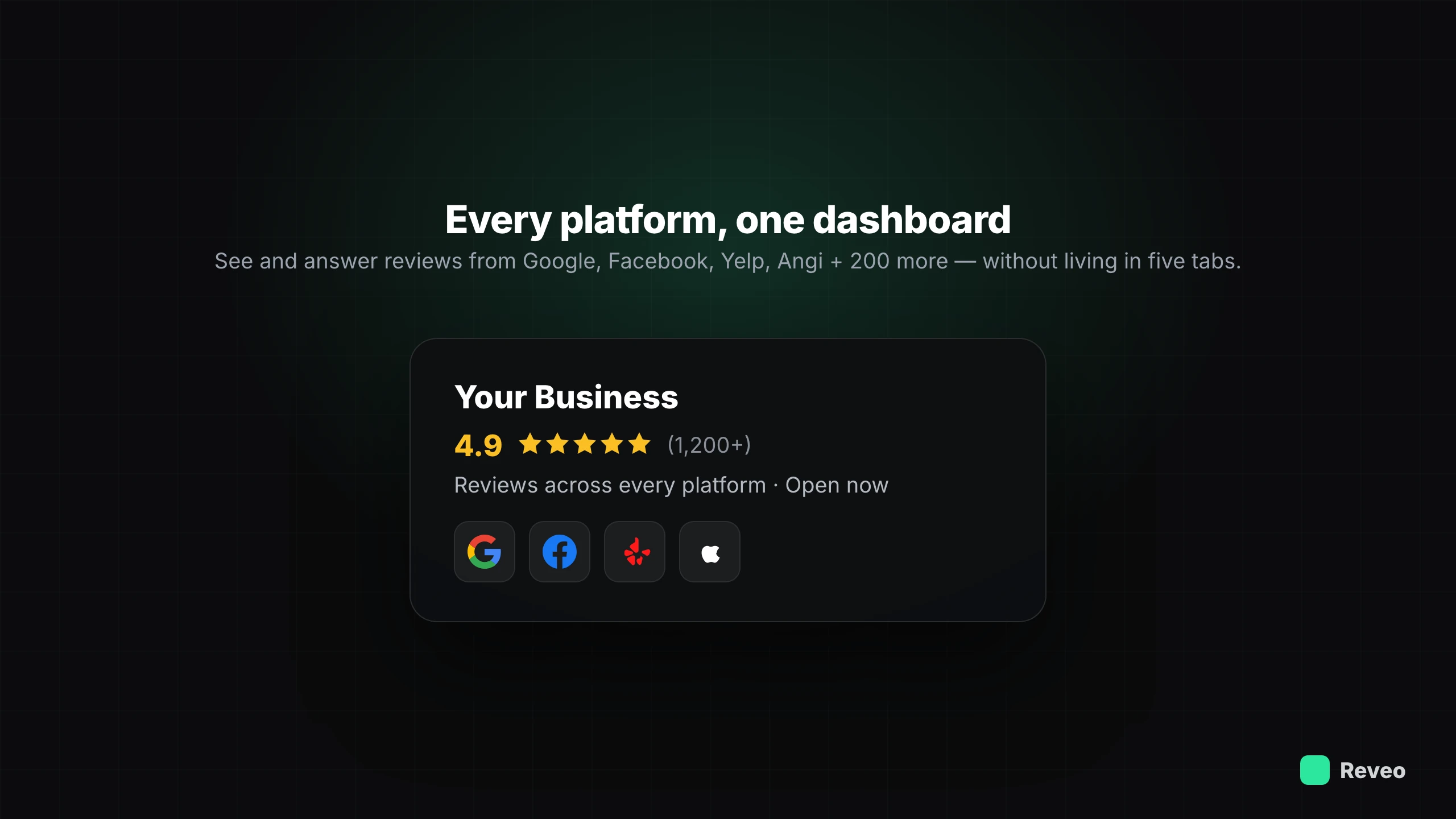
Once you’re active on Google, Facebook, and an industry site or two, the real cost isn’t earning reviews — it’s watching and responding to them across separate logins. Checking five dashboards a day for new reviews, replies, and rating changes is a job no owner has time for, so it slips, and unanswered reviews pile up.
This is the case for a single review inbox. Reveo pulls reviews from Google, Facebook, Yelp, Angi, and 200+ other sources into one dashboard: you see every new review as it lands, respond from one place with AI-drafted replies, and get an alert the same day a negative review shows up — instead of finding it a week later. Automated review requests go out the moment a job closes, routed to the platform you want to grow.
The businesses that win in 2026 aren’t the ones with a profile on every directory. They’re the ones with a deep, recent, well-managed presence on the two or three platforms their customers actually use — starting, always, with Google.
Want to see where you stand today? Run a free reputation scan for a snapshot of your reviews, rating, and listings across the platforms that matter.