


Getting to the top of the local map pack is one job; staying there is a different one. Plenty of home-service owners run a hard optimization push, reach page one, then treat the profile as finished — and watch the spot they earned drift back down over the next few months. This is the guide to the second job: how to maintain Google Business Profile rankings so the work that got you ranked doesn’t quietly undo itself.
If you haven’t done the setup yet — categories, photos, services, the full profile fill-out — start with the GBP optimization guide first. That’s the “get ranked” playbook. This one is the “stay ranked” playbook, and it’s mostly about rhythm, not one-time work.
Why a ranking you earned doesn’t stay put
Your position in the map pack isn’t a trophy you win once. Google’s local algorithm rewards businesses that keep showing signs of life — new reviews, fresh posts, current information — and it lets stale profiles slide. Three things work against you the moment you stop:
- Competitors keep going. The shop one spot below you is still asking for reviews every week. If they don’t stop and you do, they pass you. It’s that simple.
- Recency decays on its own. A review from last week counts differently than one from two years ago. Even if you never lose a review, your profile gets “older” every month you don’t add to it.
- Google keeps changing the rules. Local updates reshuffle results with no warning. A profile that’s actively maintained absorbs those shifts; one that’s coasting gets exposed by them.
None of this happens overnight. That’s the trap — the decline is slow enough that you don’t feel it until a month where the phone is noticeably quieter, and by then you’re clawing back positions instead of holding them.
The five signals you have to keep feeding
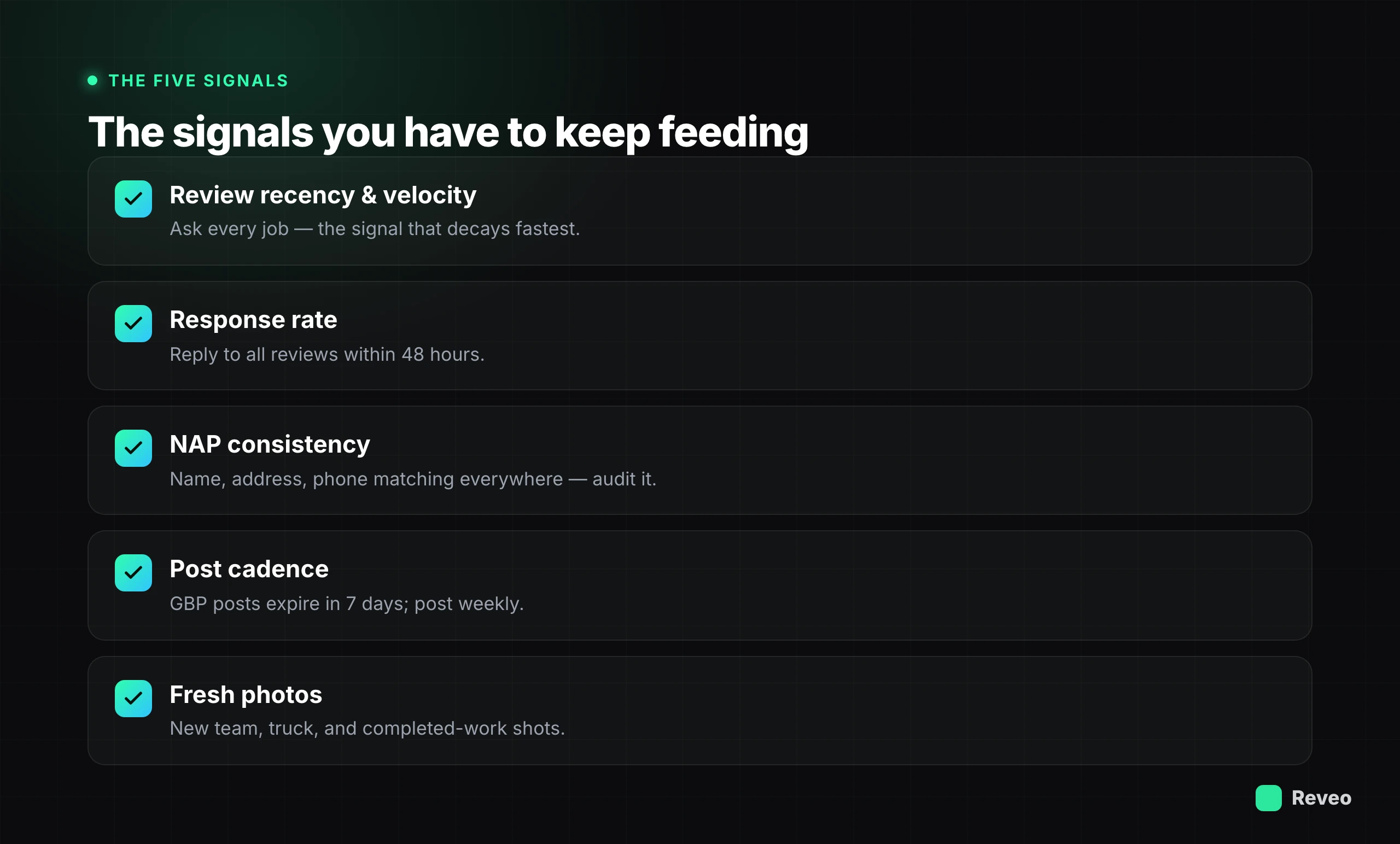
Google weighs a lot of factors, but for ongoing maintenance — as opposed to initial setup — these five are the ones that go stale if you ignore them. Setup gets them started. Maintenance keeps them alive.
1. Review recency and velocity. This is the one that decays fastest. A business with 80 reviews and ten new ones this month looks more active to Google than one with 200 reviews and none since spring. The fix isn’t asking better — it’s asking every time, after every job, so the flow never stops. EcoStar Pest Control sits at 1,015 reviews from a single location not because of one great month, but because owner Pete Updike never let the ask lapse.
2. Response rate. Reply to reviews — all of them, the five-stars and the one-stars. Google reads response rate as a sign you’re engaged, and future customers read your replies to decide how you handle problems. An unanswered negative review is worse than the review itself. Set a standard — every review answered within 48 hours, same-day when you can — and hold to it.
3. NAP consistency. Your name, address, and phone number have to match across your profile, your website, and every directory. Drift creeps in — a suite number changes, “St.” becomes “Street,” an old number lingers on Yelp. Small mismatches confuse Google and chip at your authority, so this needs a periodic audit, not a one-time fix.
4. Post cadence. GBP posts expire after seven days. Post weekly — an offer, a finished job, a seasonal reminder — and your profile always looks current. Go quiet and it reads as abandoned.
5. Fresh photos. New images of your team, your trucks, and completed work keep the profile alive and give customers a reason to trust you before the first call. A photo library that hasn’t changed in a year is a stale-profile signal.
Notice these compound. The longer you hold the rhythm, the wider the gap between you and a competitor who’s coasting — and the harder you are to overtake.
The monthly rhythm
Maintenance works when it’s a routine someone owns, not a thing you remember when rankings dip. These are the tasks that need to happen every month, without exception:
- Ask every customer for a review. Automated requests after every job, appointment, or transaction. Consistency is the whole game — ask every time, not only when you assume the customer is happy.
- Respond to every review within 48 hours. Speed is a signal to both Google and the next person reading your profile. Same-day when you can.
- Post at least once a week. Seasonal offers, new services, recent project photos — anything that gives Google fresh content and keeps the profile from expiring back to blank.
- Upload two or three new photos. Before/after shots, team photos, or a 15-second video walkthrough. Fresh visuals read as an active, working business.
- Confirm hours and contact info. Holiday hours, seasonal changes, and phone updates are easy to miss. Wrong info frustrates customers and erodes Google’s trust in the listing.
- Read your GBP Insights. Profile views, searches, and customer actions. Falling numbers here often show up before a ranking drop does — this is your early-warning system.
The quarterly deep pass
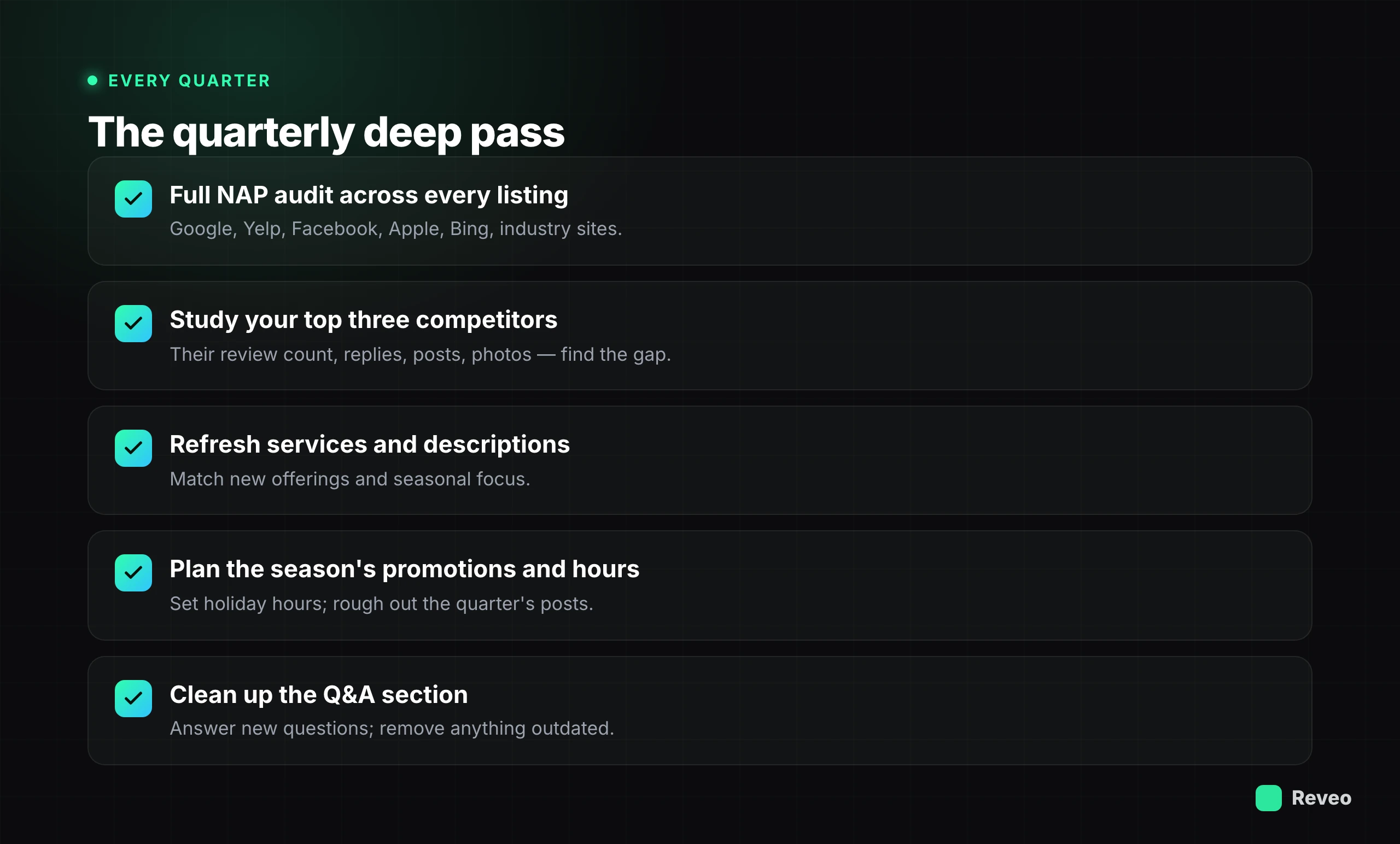
Every 90 days, step back for the slower-moving issues a monthly pass won’t catch:
- Full NAP audit across every listing. Google, Yelp, Facebook, Apple Maps, Bing, and your industry directories. Fix any inconsistency the moment you find it.
- Study your top three competitors. Search your money keywords and look at who’s ranking. Note their review count, how they respond, how often they post, how many photos they have. Find the gap you can close.
- Refresh services and descriptions. Update your business description, service list, and categories to match new offerings or seasonal focus. Keep it aligned with what customers are actually searching.
- Plan the season’s promotions and hours. Set holiday and seasonal hours ahead of time, and rough out the next quarter’s posts so weekly posting never becomes a scramble.
- Clean up the Q&A section. Answer new questions, add the ones customers keep asking, and remove anything outdated. It’s public, and it influences the decision.
Make the rhythm automatic — or it won’t survive a busy month
Here’s the honest problem: none of the above is hard to understand. It falls apart because you’re running trucks and crews, and profile maintenance is the first thing that slips when a week gets full. The tasks aren’t difficult — they’re just relentless, and relentless loses to a busy Tuesday.
The businesses that hold their rankings for years take themselves out of the loop. Legion Pest Control is holding 994 reviews it collected over two years, and owner Brandon Jamison’s whole involvement is this: “I look at the dashboard once a week. The system runs itself.” That’s the target — the maintenance still happens every day, but it doesn’t depend on anyone remembering.
That’s the part Reveo handles:
- Automated review requests fire after every job via text and email, so review velocity never stalls between busy weeks.
- AI-drafted responses put an on-brand reply on every review within minutes, which you approve — so your response rate holds without eating an afternoon.
- Listings monitoring flags NAP errors and unauthorized edits the moment they happen, instead of at your next quarterly audit.
- Post scheduling lets you queue weeks of updates in advance, so the profile stays fresh even when you’re slammed.
Scoop Soldiers runs this across a 47-location franchise and keeps review velocity roughly 10× what it was manually — at that scale, no human is going to chase the ask location by location, so the system does it. That’s the difference between maintenance that survives a hard month and maintenance that quietly stops.
Where to start
You don’t need a new project. You need to make three things recurring instead of occasional:
- Turn review requests into a standing routine — automatic, after every job, so velocity never depends on memory.
- Set a response SLA and hold it — every review answered within 48 hours, negatives first.
- Put the monthly and quarterly checklists on a calendar with one person’s name on them.
Do that and your review count, your rating, and your ranking hold their ground — and keep pulling away from the competitor who thought getting to page one was the finish line. If you’re also working the broader search side, the local SEO guide covers how GBP maintenance feeds the rest of it.
Want to see where your profile stands right now? Run a free reputation scan for a snapshot of your reviews, rating, and listings in a couple of minutes.