
Why Google Reviews Matter More for HVAC
Google reviews are more consequential for an HVAC contractor than for almost any other home-service vertical. The jobs are bigger, the buying window is shorter, and the customer is almost always shopping more than one company before they hand over a check.
An emergency no-cool call in July or a no-heat call in January is not a leisurely decision. The homeowner is hot, cold, stressed, and scrolling. They search “HVAC near me,” look at the map pack, and pick one of the top three results — overwhelmingly the ones with the most recent 5-star reviews. If your count is thin or your last review is from eight months ago, you are invisible at the exact moment it matters.
It gets harder on the high-ticket end. A full system replacement is an $8,000–$18,000 purchase. Nobody hands that over without reading reviews, cross-checking the BBB, and getting two or three quotes. Your review profile is the first filter in a multi-bid comparison — and if you do not make it past that filter, the estimator never gets the call.
BrightLocal
- bids the average homeowner collects on a system replacement — ACHR NEWS industry data
The Timing That Actually Matters
HVAC has three natural review moments, and each one converts differently. Pick the wrong one and you leave reviews on the table. Pick all three, staged correctly, and you turn every customer into two or three chances to earn a review.
Immediately after the tech leaves the house — For service calls and repairs, the best window is 0–2 hours after the job is marked complete. The AC is cold again, the technician was friendly, and the relief is fresh. This is your single highest-converting moment and it should be automated, not left to the tech or the office.
24 hours after a big install — For a full AC or furnace replacement, wait a day. The homeowner has lived with the new system through an evening and a morning, heard how quiet it runs, and felt the comfort improvement. Asking the same afternoon the install crew rolls out is too early — they have not experienced the product yet.
End-of-season for maintenance members — Maintenance plan customers see you twice a year. After the spring AC tune-up or the fall furnace check, send a single review ask that frames the value of their membership. These are your happiest, most loyal customers and they tend to write the longest reviews — which Google weights.
One hard rule: do not send a review request while the tech is still at the house. It reads as pressure and customers feel cornered. Fire the ask from the dispatch system the moment the job is closed out — never before.
Which Channel Wins for HVAC: SMS vs Email
The conventional wisdom is simple: SMS beats email by a wide margin. SMS gets roughly 98% open rates against email’s 20%, and for an industry where the request needs to land while the experience is fresh, that matters. But HVAC has a twist — your customer base can skew older than, say, carpet cleaning or house cleaning, and that changes the calculus.
Residential HVAC customers are often homeowners 45–75, many of whom still prefer email for anything they have to “think about.” They are perfectly capable of tapping an SMS link, but some will ignore a text from an unknown short code on principle. The answer is not to pick one — it is to send both, staggered.
SMS first, 30 minutes after job complete — Short, direct, first name, one link to the Google review page. This catches the ~60% of HVAC customers who prefer text.
Email the next morning if no review posted — Longer message, company letterhead, photo of the tech who did the work. This catches the email-first customers and the ones who meant to get to the SMS and forgot.
Stop after two touches — One SMS, one email. If the customer has not reviewed by then, let it go. Nagging burns goodwill and invites the occasional petty 1-star out of spite.
3 Templates That Work for HVAC
These are battle-tested on heating and cooling jobs. Swap in your variables, send from your tech’s first name where the platform allows, and drop the direct Google review link at the end.
SMS · AC Install
Hi {first_name}, it’s Mike from {company}. Hope the new {equipment} is keeping you cool. If the crew took care of you, a quick Google review would mean a lot to our team. Takes 30 seconds: {review_link}
SMS · Furnace Repair
Hi {first_name}, {tech_name} here from {company}. Glad we got the heat running again today. If you have a minute, a Google review helps other homeowners find us when their furnace goes out: {review_link}
Email · Maintenance Member (end of season)
Subject: Thanks for another season, {first_name} We wrapped your {spring_tune_up / fall_check} this week and your system is set for the next few months. Maintenance members like you are the reason we can keep response times fast — and the reason most of our new customers find us. If we have earned it, a short Google review goes a long way: {review_link} Thanks, {owner_first_name} {company}
The Filter-Before-Google Play (Done Right)
HVAC contractors get burned more often by one 1-star review than by missing five 5-stars. A single angry post about a botched install can kill your map pack ranking for months. The right play is not review gating — Google explicitly prohibits that and will penalize you for it — but you can ethically surface unhappy customers before they reach Google.
The compliant pattern is simple: send every customer a short, private survey first. Ask one question — “How did we do?” If they say “great,” the follow-up page invites them to share on Google. If they say “something went wrong,” route them to a private feedback form that hits the owner’s inbox in real time, so you can call them that afternoon and make it right.
Every customer gets the public Google link in a separate, later request — you are not hiding the option. What the survey does is give you a fighting chance to fix the problem before an angry 1-star lands. That is the difference between ethical recovery and gating: the customer can still leave a public review, you just got a chance to solve the issue first.
The line to stay behind: Never condition the Google ask on the survey answer. Every customer gets the same chance to post publicly. The survey is an early warning system, not a filter.
The Compound Effect: How HVAC Customers Actually Research
A homeowner shopping a new furnace does not just glance at one page. They cross-reference. Understanding that research path tells you where else your review presence has to show up beyond Google.
1
Google Search & Maps — The first stop. Map pack, star rating, review count, recency of last review. This is 70% of the decision for emergency calls and about 40% for replacements.
2
Better Business Bureau — Older homeowners in particular still check BBB for A+ ratings and unresolved complaints. If you have open BBB complaints, close them before you run a review push — it will undercut everything else.
3
Angi and HomeAdvisor — Less dominant than they were, but still a shopping destination for replacements where the homeowner wants multiple quotes in one form. A thin profile here kills you in that funnel.
4
Nextdoor and Facebook — The neighbor recommendation layer. You cannot directly solicit these, but a strong Google presence and steady customer volume will produce them organically.
Google is the top of the funnel, but the homeowner is looking for consistency across sources. Spend 80% of your review effort on Google — it is the highest-leverage spot — and keep the other profiles clean and claimed so they do not raise a flag when the shopper cross-checks.
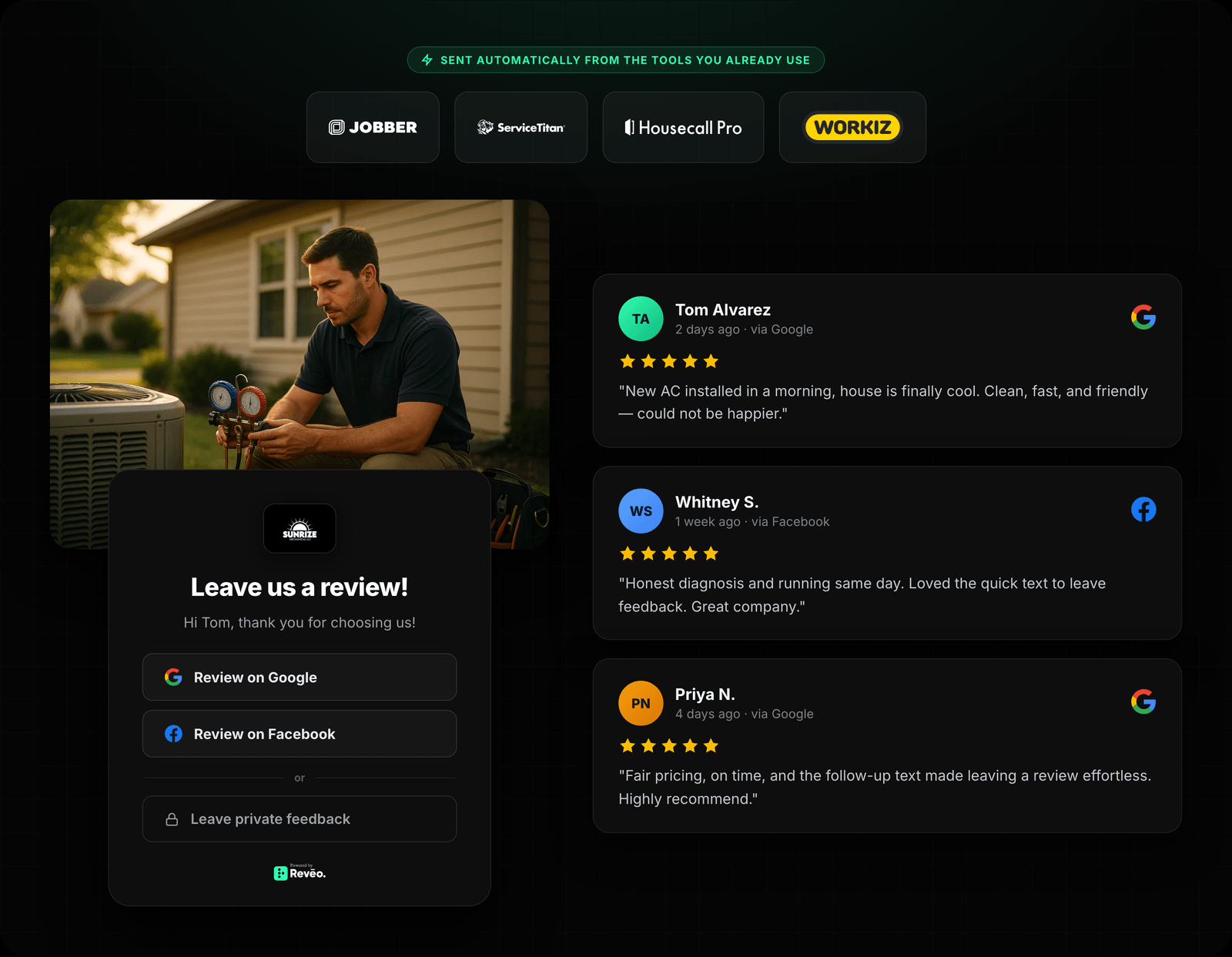
Automate Review Requests After Every HVAC Job
Reveo connects to ServiceTitan, Housecall Pro, FieldEdge, and more. Job complete triggers the ask — every time, without your team remembering.