

Why Reviews Matter More in Pest Control Than Almost Any Other Trade
Pest control is a review-driven business whether you like it or not. Homeowners don’t shop around by price — they shop by trust. When someone finds termites in a baseboard or roaches in the kitchen at 10pm, they grab their phone, type “exterminator near me,” and call whichever company has the highest stars and the most recent reviews. If you’re not the first three results, you’re not getting the call.
Three things make pest control unique: it’s a recurring service model (quarterly plans, monthly mosquito, bi-monthly rodent), it’s heavily referral-driven (neighbors talk, HOAs share, Nextdoor explodes), and the emotional stakes are high. A squeamish customer who just watched a tech drag a rat trap out of their attic is going to tell ten people — good or bad. Your job is to make sure that story ends with a Google review, not a Nextdoor rant.
This guide is written for pest control operators: general pest, termite, mosquito, wildlife, bed bug, rodent. The tactics below are built around the treatment cadence you already run, not a generic home-service template.
The Timing Question: First-Visit vs. Recurring
This is where most pest control companies get it wrong. They either blast a review request after every single visit (customers tune out by the second one) or they only ask on the initial install (and miss 80% of the opportunity across the rest of the year). The right answer is cadence-aware.
First-visit treatment: ask 48-72 hours later. Not immediately. Pest control is unique — the customer can’t judge your work until the bugs actually stop showing up. Wait two or three days so they’ve seen activity drop, then send the request while the relief is fresh. This one window is your biggest review goldmine.
Recurring visits: ask once per year, not every quarter. A customer on a quarterly plan doesn’t want four review requests a year — they’ll get annoyed. Pick the visit where the tech built the most rapport (usually the spring or fall treatment) and ask then. Everyone else gets a thank-you text, not a review ask.
Emergency jobs: ask within 24 hours. Bed bugs, hornets’ nest by the front door, rats in the attic — emergency service is when emotions are highest and gratitude peaks. Strike while the relief is loud. These are the reviews that contain actual storytelling, and those reviews convert.
Termite or wildlife removal: ask at 7-10 days. These are high-ticket, high-anxiety jobs. The customer needs to see that the yellow jackets didn’t come back, the raccoon stayed gone, the termite bait stations are intact. Give them a week of peace-of-mind, then ask.
The principle behind all of this: ask when the customer can honestly say it worked. In pest control, “it worked” takes time. Respect that and your response rate doubles.
SMS Beats Email — And You Should Send a Before/After Photo
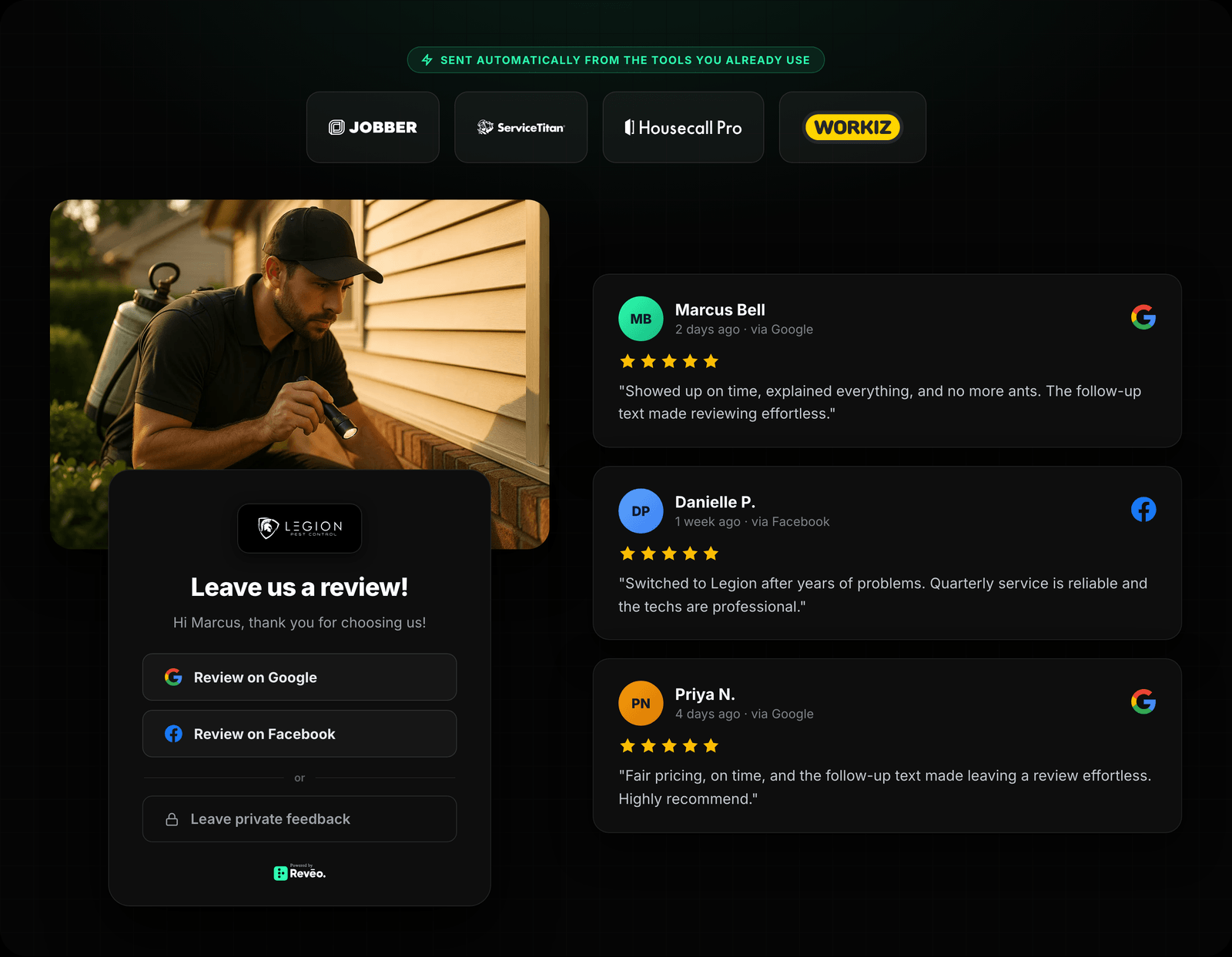
In most home service verticals, SMS wins because of open rate. In pest control it wins for a second reason: your techs already have photos on their phone. A rodent station installed, a wasp nest removed, a termite trench cut, a sealed entry point — these are shareable, tangible proof. Email gets ignored, but an MMS with a before/after photo and a one-tap Google link converts.
Attach an immediate before/after photo. The wasp nest is gone. The rodent trap is set. The termite bait stations are installed. Send the photo in the review request message. It reminds the customer exactly what you did and gives them something to reference when they write the review.
Use the tech’s name. “Mike just finished up” converts 2x better than “Our team just finished up.” Customers remember the person, not the company. Pest techs build real relationships — let the message reflect that.
One-tap Google link, nothing else. No app install, no star selector, no “how was your experience?” pre-screen. Tap the link, land on your Google review page, type a sentence, done. Every extra step kills a review.
4 Pest Control SMS Templates That Actually Work
Copy these, swap your tech and company name, and send them through whatever tool you use (Reveo automates this off your CRM trigger). Keep them under 160 characters where possible so they stay as a single SMS.
Template 1 — First-Visit Treatment (send 48 hours later)
Hi {{first_name}}, it’s Mike from {{company}}. Hope the ants are staying out after Tuesday’s treatment. Would mean a lot if you’d share a quick review: {{review_link}}
Template 2 — Recurring Quarterly Service
Hey {{first_name}} — {{tech_name}} here. Finished your spring treatment, hit the perimeter and the garage. A quick Google review helps us keep your neighborhood covered: {{review_link}}
Template 3 — Emergency Infestation (send next day)
{{first_name}}, glad we could get those hornets handled fast yesterday. If you have 30 seconds, a short review really helps us out: {{review_link}} — {{tech_name}}
Template 4 — Move-Out / One-Time Cleanout
Hi {{first_name}}, hope the move-out cleanout made things easier. If {{tech_name}} treated you right, a quick Google review goes a long way: {{review_link}}
Pro tip: Pest pros using Reveo see a 7-9% review conversion rate on first-visit requests sent 48-72 hours after treatment — roughly double what they get at the 0-hour mark.
Catch “Bugs Came Back” Feedback Before It Hits Google

Here’s the part most pest companies skip. In pest control, three specific complaints repeat over and over: “bugs came back,” “my pet got sick after the spray,” and “the tech was rude/in a hurry.” Those three phrases, left unaddressed, become 1-star reviews that can sink a location for months. You want to intercept them before they hit Google — not by gaming anything, but by giving the customer a better place to vent first.
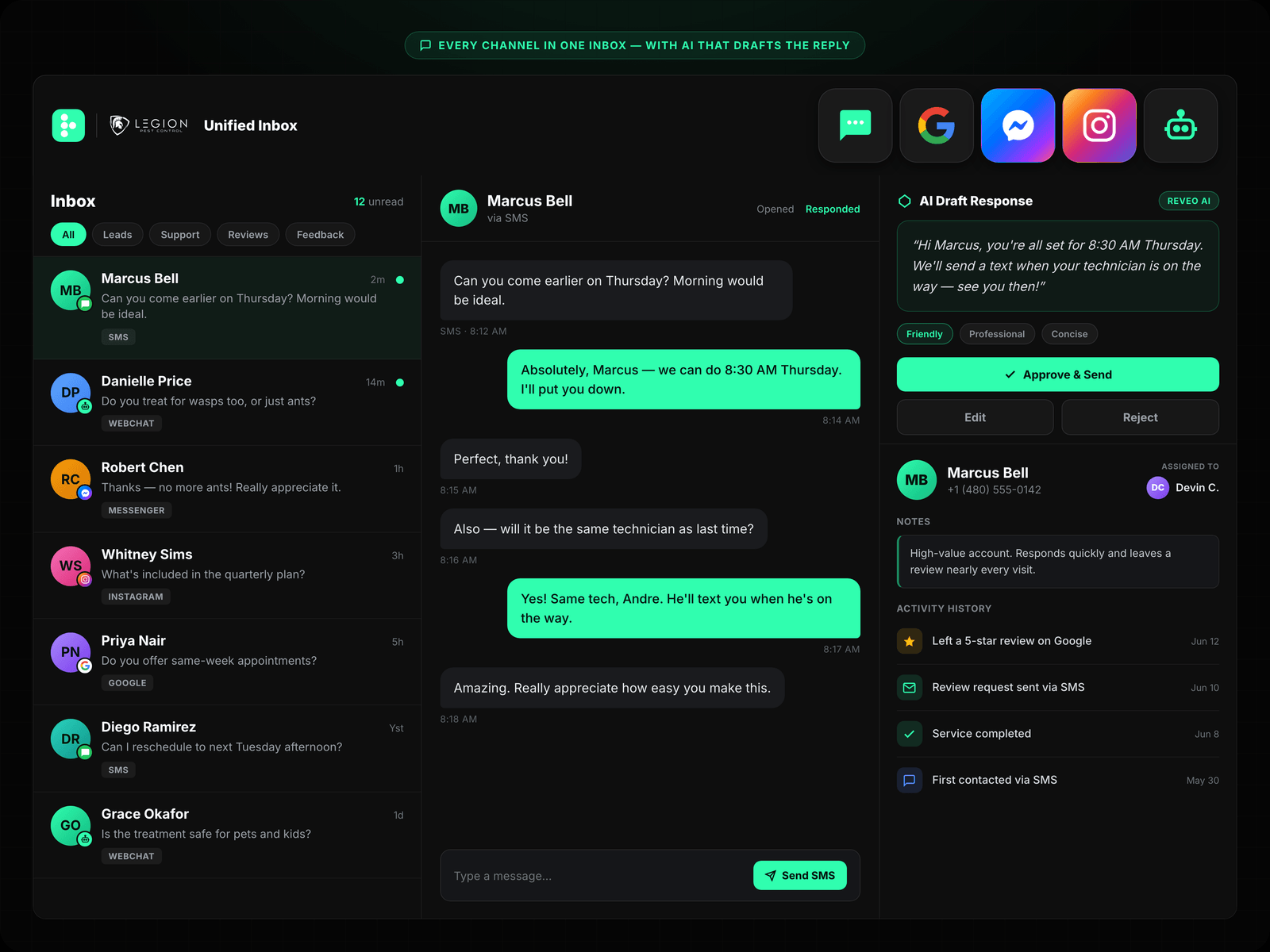
The workflow: send every customer the same review request. For the ones who reply to SMS with a concern instead of tapping the review link, route that conversation to your office or owner immediately. Fix it — re-treat, refund, apologize, whatever it takes — then ask for the review after the problem is resolved. Happy resolution reviews are some of the best reviews you’ll ever get because they show recovery.
Watch for “bugs came back.” Auto-flag any inbound reply containing “still seeing,” “came back,” “not working,” “didn’t work.” Route to the service manager within the hour. Offer a free re-treatment the same week. Most customers don’t want revenge — they want the bugs gone.
Pet-safety concerns are a legal landmine. If a customer mentions a pet got sick, stop the automation immediately. Have a senior person call that day. Document the product used, the application rate, the MSDS. Pet-safety reviews on Google are among the most damaging reviews in the industry — they scare off entire neighborhoods.
“Tech was rude” needs coaching, not hiding. One complaint about a specific tech is a coaching opportunity. Three on the same tech is a hiring problem. Track it. Customers will forgive a bad day if you own it quickly.
Important: This is not review gating. You’re sending every customer the same Google review link. You’re just also listening for problems in the replies and fixing them before asking for the review again. Google is fine with that — what Google prohibits is only sending the happy customers to Google.
The Compound Effect: Neighborhoods, Nextdoor, and Review Velocity
Pest control is one of the most geographically clustered industries in home services. Ants don’t respect property lines. If one house on the block has roaches, the two houses next to it are probably thinking about it. When you earn one review from a neighborhood, you’ve planted a flag — and Google notices.
Review velocity — the rate at which you earn new reviews over time — matters more in pest control than in almost any other vertical. Google’s local algorithm rewards consistency. Ten reviews over three months beats thirty reviews in one month. A steady drip of fresh reviews, with recent dates, signals to Google that your business is active and relevant. That’s how you hold your Map Pack position through the slow season.
Nextdoor is your free distribution channel. When customers post “does anyone know a good exterminator?” in their Nextdoor group, the answer should be your name — three times. That only happens if you’ve built a base of happy customers who remember you. Every SMS review request you send is also planting seeds for a Nextdoor recommendation six months later.
Put It All Together
Pest control reviews come down to four things: ask at the right moment in the treatment cycle, send via SMS with a before/after photo, filter feedback before it hits public, and keep the velocity steady across the year. Do that and your Map Pack position stops being a guessing game.
Your next steps:
1
Set up automated SMS requests off your “treatment complete” CRM trigger
2
Delay first-visit requests by 48-72 hours; ask recurring customers once a year
3
Use the tech’s name and attach a before/after photo from the job
4
Auto-flag “bugs came back,” pet-safety, and rude-tech replies to a senior person
5
Respond to every review, positive or negative, within 48 hours
Built for Pest Control Operators
Reveo automates review requests off your pest control CRM, captures before/after photos, and routes “bugs came back” replies to the right person instantly.